


 Menu
MenuMenu


Get Sales Advice from Mon - Fri 9am - 5:00pm:
020 3337 8950LAST UPDATED: June 10, 2026
Ray Tracing vs Path Tracing: What’s the Difference and Which Is Better?
The difference between path tracing vs ray tracing comes down to how deeply a game or rendering engine simulates light. Both technologies aim to make digital scenes look more realistic, but they do it at different levels of complexity.
Ray tracing follows rays of light to create more realistic effects such as reflections, shadows, and lighting. It is already used in many modern games because it can improve visual quality while still being possible to run in real time on supported hardware.
Path tracing goes further. It is a more advanced form of ray tracing that simulates light bouncing around a scene many times, creating more natural shadows, indirect lighting, reflections, and colour bleeding. It can look much closer to real life, but it is also far more demanding on your GPU.
For gamers, the simple answer is this: ray tracing is better for balanced visuals and performance, while path tracing is better for maximum realism if your PC or laptop is powerful enough.
What Is Path Tracing?
Full Light Simulation Explained Simply
Path tracing is a rendering method that tries to simulate how light behaves in the real world. Instead of only calculating selected light effects, it follows many light paths as they bounce around a scene.
In real life, light does not simply hit an object and stop. It bounces from walls, floors, glass, metal and other surfaces. It also picks up colour along the way. For example, light bouncing off a red wall can slightly tint nearby objects red.
Path tracing tries to recreate that behaviour. It calculates direct lighting, indirect lighting, reflections, shadows and ambient light in one more complete system.
This is why path tracing can look so realistic. It does not just add better reflections or sharper shadows. It changes the way the whole scene is lit.
Why It Looks So Realistic
Path tracing looks realistic because it handles light more naturally. It can create softer shadows, more accurate reflections, realistic ambient lighting and better colour bleeding.
In a normal game scene, some areas may look artificially bright or dark because the lighting is simplified. With path tracing, the light behaves more like it would in the real world, so rooms, streets, reflections and objects can feel more grounded.
This is especially noticeable in dark interiors, neon-lit streets, reflective surfaces and scenes with many light sources. Games like Cyberpunk 2077 use a full ray tracing mode, often discussed as path-traced or “Overdrive” lighting, to create more natural reflections and lighting across complex scenes. NVIDIA describes Cyberpunk 2077’s Ray Tracing: Overdrive Mode as a full ray tracing mode that improves diffuse and specular lighting response for more realistic reflections and lighting balance.
Where It’s Used in Modern Games
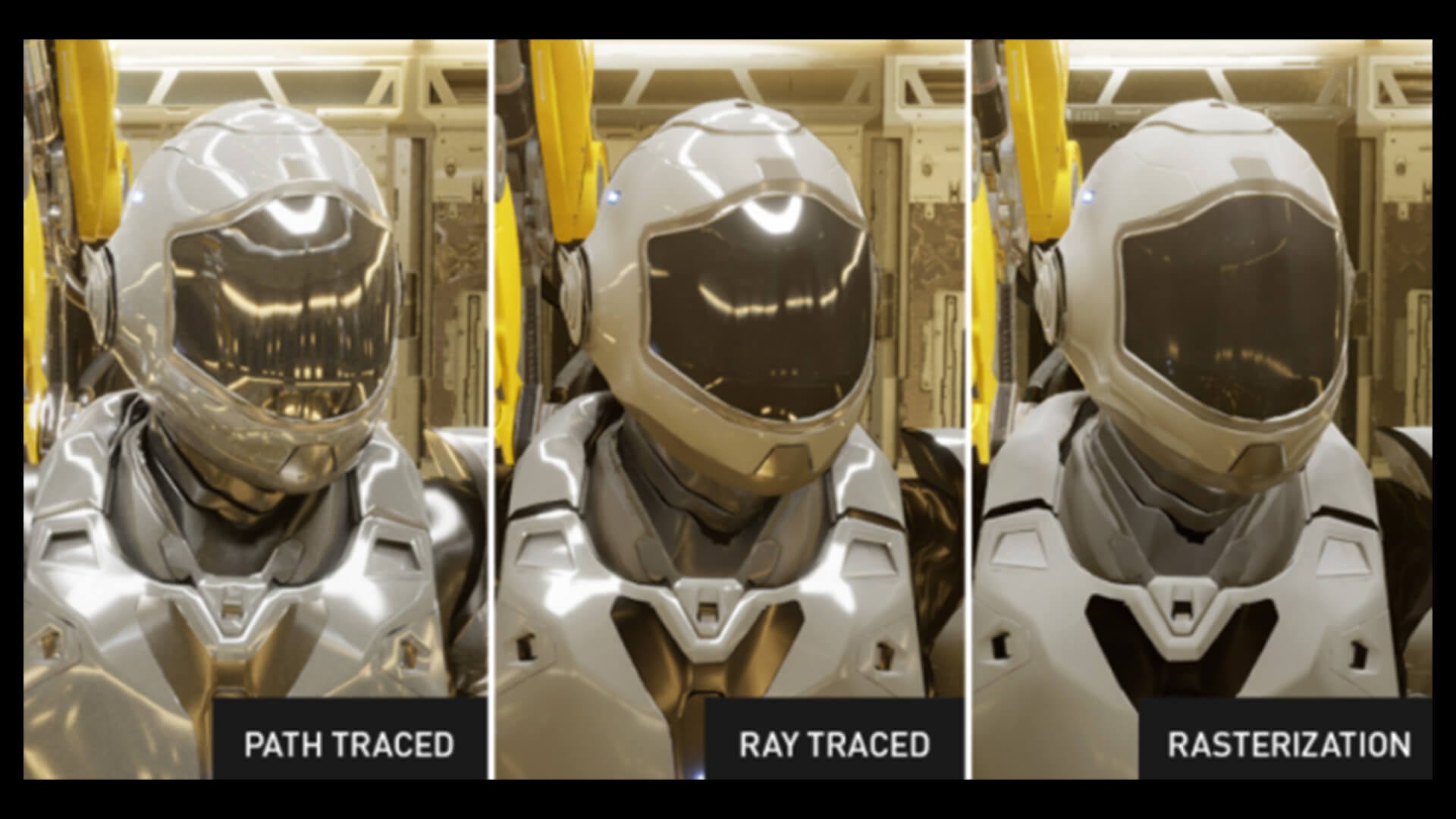
Path tracing is still not used in every game because it is extremely demanding. You will usually find it in showcase titles, advanced PC releases, RTX-enhanced updates or games designed to push graphics technology forward.
Examples include:
| Game or Technology | Path Tracing Use |
| Cyberpunk 2077: Overdrive Mode | Full ray tracing / path-traced lighting approach |
| Alan Wake 2 | Full ray tracing with DLSS 3.5 and Ray Reconstruction |
| Portal with RTX | RTX Remix path-traced lighting showcase |
| Half-Life 2 RTX | RTX Remix path-traced visual upgrade project |
| 007 First Light | Announced with path-traced effects and DLSS 4.5 support |
NVIDIA has also announced newer path-traced effects and DLSS technologies for future games such as 007 First Light, showing that path tracing is becoming a bigger part of next-generation PC visuals.
What Is Ray Tracing?
How Ray Tracing Works
Ray tracing is a rendering technique that tracks rays of light to improve how scenes look. In games, it is usually used for specific visual effects rather than simulating all lighting in the scene.
For example, ray tracing can improve:
- Reflections in water, glass and metal
- More realistic shadows
- Global illumination
- Ambient occlusion
- Light bouncing in selected areas
Traditional game lighting often uses shortcuts to imitate realistic effects. Ray tracing calculates some of those effects more accurately, which can make a game feel more immersive.
Ray tracing is handled through DXR, including ray generation, ray-geometry interaction, acceleration structures and shader stages used by modern real-time graphics pipelines.
Real-Time Lighting in Games
The important phrase is real-time graphics. In films and professional rendering, a single frame can take a long time to render. In games, the image has to be generated many times per second while you play.
That is why game ray tracing is often selective. A game may use ray tracing for reflections but keep other lighting traditional. Or it may use ray-traced shadows but not full path-traced lighting.
This allows the game to look better without completely destroying frame rates.
Where You See It Today
You can see RTX ray tracing in many modern PC games. It is common in titles that support NVIDIA RTX GPUs, AMD ray tracing hardware, or modern console graphics features.
Popular ray tracing games include:
- Cyberpunk 2077
- Control
- Metro Exodus Enhanced Edition
- Minecraft with RTX
- Forza Motorsport
- Alan Wake 2
- Dying Light 2
- Spider-Man Remastered
- The Witcher 3 next-gen update
Ray tracing is now much more common than path tracing because it offers a better balance between visual quality and performance.
Path Tracing vs Ray Tracing: Key Differences
Lighting Accuracy
The biggest difference between path tracing vs ray tracing is lighting accuracy.
Ray tracing usually improves selected effects. It can make reflections more accurate or shadows more realistic, but the rest of the scene may still rely on traditional lighting techniques.
Path tracing tries to simulate the full lighting environment. It handles more of the light behaviour in one system, which makes the scene feel more natural.
| Feature | Ray Tracing | Path Tracing |
| Main focus | Specific effects | Full lighting simulation |
| Reflections | Realistic | More physically accurate |
| Shadows | Improved | Softer and more natural |
| Indirect lighting | Sometimes used | Core part of the technique |
| Colour bleeding | Limited | More realistic |
| Performance cost | High | Very high |
Realism and Visual Quality
For visual quality, path tracing usually looks better. It creates more realistic lighting because it handles multiple light bounces and indirect illumination.
However, that does not mean ray tracing looks bad. Ray tracing can still make a major difference in games, especially when used well. Reflections, shadows, and realistic lighting can make environments feel much more believable than traditional rasterised graphics.
The difference is that path tracing is more complete. Ray tracing improves parts of the image. Path tracing can transform the whole lighting model.
Performance Impact
Performance is where ray tracing has the advantage.
Ray tracing is demanding, but many modern GPUs can run it at playable frame rates, especially with upscaling enabled. Path tracing is much heavier because it performs far more light calculations.
This means path tracing can reduce FPS dramatically without help from AI upscaling or frame generation. NVIDIA notes that Alan Wake 2’s full ray tracing experience uses DLSS 3.5 technologies, including Ray Reconstruction, with RTX 40 Series GPUs seeing large 4K performance gains when DLSS is enabled.
For gamers, this means path tracing is usually best reserved for high-end GPUs, strong gaming PCs and users who care more about visuals than maximum FPS.
Performance and Hardware Requirements
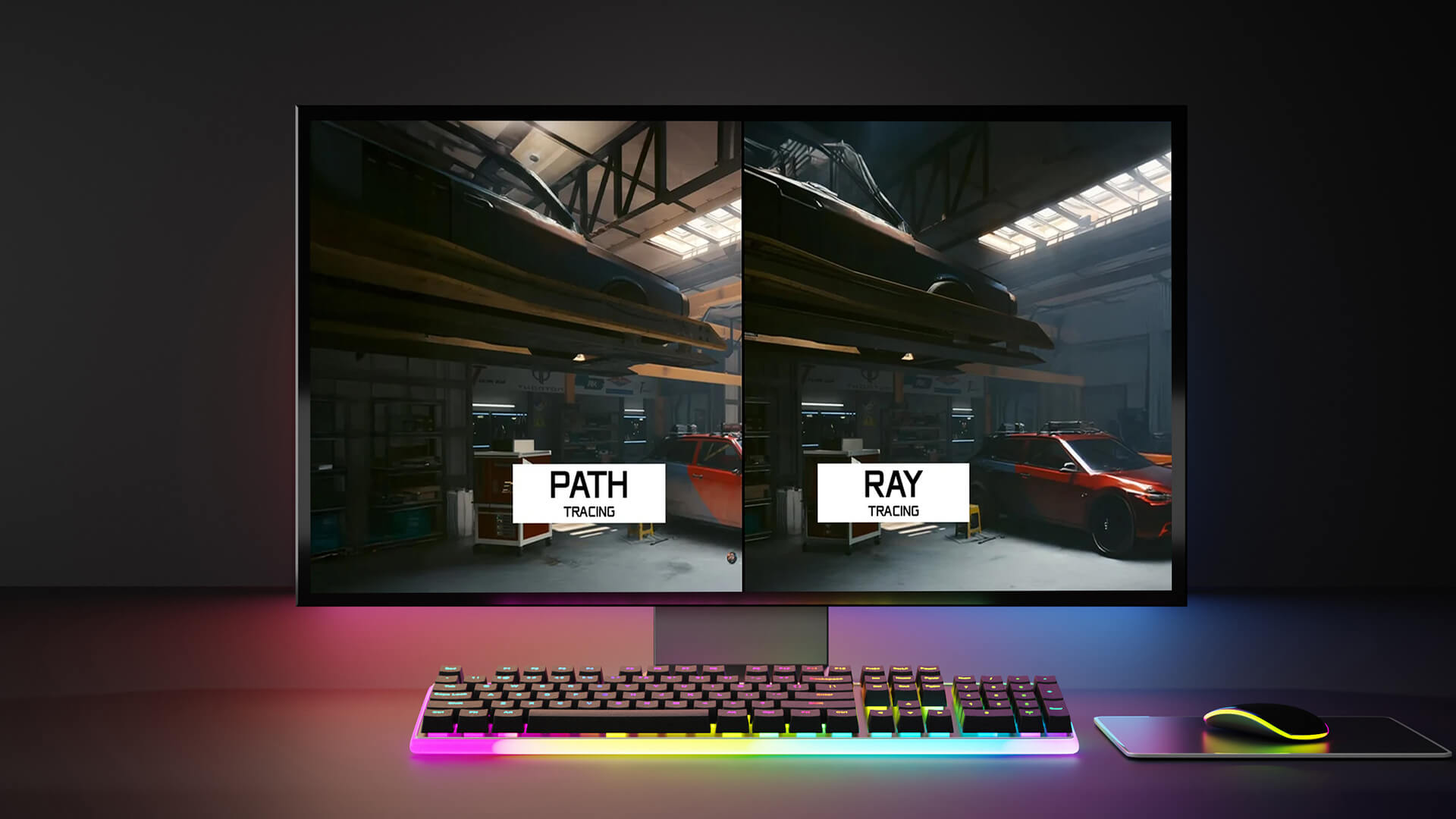
Why Path Tracing Is More Demanding
Path tracing is more demanding because it simulates more light behaviour. Instead of tracing a smaller number of rays for selected effects, it needs many more samples and bounces to create a clean image.
That creates three big challenges:
| Challenge | What It Means for Gaming |
| More GPU workload | Lower FPS without upscaling |
| More memory demand | Higher VRAM use in complex scenes |
| More noise to clean up | Needs denoising and AI reconstruction |
Without modern GPU hardware and AI tools, path tracing can be too slow for real-time gaming.
GPUs Needed for Each Technology
For standard ray tracing, modern mid-range and high-end GPUs can usually handle it, depending on the game, resolution and settings.
For path tracing, you need much stronger hardware. High-end RTX GPUs are currently the best-known option because they combine ray tracing hardware with DLSS and Ray Reconstruction.
A simple guide:
| Target Experience | Recommended Hardware Direction |
| Basic ray tracing at 1080p | Modern RTX or Radeon GPU with adjusted settings |
| Ray tracing at 1440p | Stronger RTX / Radeon GPU with upscaling |
| Ray tracing at 4K | High-end GPU and DLSS / FSR |
| Path tracing at 1440p | High-end RTX GPU recommended |
| Path tracing at 4K | Premium RTX GPU and AI upscaling strongly recommended |
If you are building for future path tracing, browse next-gen GPUs for path tracing. If you want a complete system, explore powerful PCs for modern games.
Role of AI Upscaling: DLSS and FSR
AI upscaling is one of the main reasons path tracing is becoming possible in real-time games.
Technologies such as DLSS and FSR help improve performance by rendering at a lower internal resolution and then upscaling the image. NVIDIA’s Ray Reconstruction also helps improve ray-traced and path-traced image quality by using AI to generate cleaner lighting results.
For players, the benefit is simple: upscaling helps make demanding lighting features playable.
Without upscaling, path tracing is often too heavy for smooth gameplay at high resolutions.
Which Games Use Path Tracing vs Ray Tracing?
Popular Ray Tracing Games
Ray tracing is now available in many modern games. It is commonly used for reflections, shadows, global illumination or ambient occlusion.
Popular ray tracing games include:
| Game | Ray Tracing Use |
| Control | Reflections, lighting and shadows |
| Cyberpunk 2077 | Reflections, shadows, lighting and full ray tracing mode |
| Metro Exodus Enhanced Edition | Ray-traced global illumination |
| Minecraft with RTX | Ray-traced lighting effects |
| Forza Motorsport | Ray-traced reflections and lighting features |
| Spider-Man Remastered | Ray-traced reflections |
| The Witcher 3 next-gen | Ray-traced lighting and reflections |
Ray tracing is a good option if you want better visuals but still care about frame rate.
New Path Tracing Titles
Path tracing is still less common, but it is growing.
Notable path tracing games and projects include:
| Game or Project | Path Tracing Relevance |
| Cyberpunk 2077 Overdrive | Full ray tracing / path-traced lighting mode |
| Alan Wake 2 | Full ray tracing enhanced with DLSS 3.5 |
| Portal with RTX | RTX Remix path-traced remake |
| Half-Life 2 RTX | RTX Remix project with advanced lighting |
| 007 First Light | Announced path-traced effects with DLSS 4.5 support |
NVIDIA RTX Remix is also helping classic games receive path-traced lighting upgrades, with the platform designed to relight scenes using path-traced lighting and modern assets.
What’s Coming Next
Path tracing is likely to become more common as GPUs become faster, and AI upscaling becomes more advanced. However, it will not replace standard ray tracing overnight.
Most games will continue to use a mix of traditional rendering, ray tracing and AI upscaling because that balance works across more hardware.
In the long term, path tracing is likely to become the premium visual mode for high-end PCs and flagship games.
Which One Should You Use?
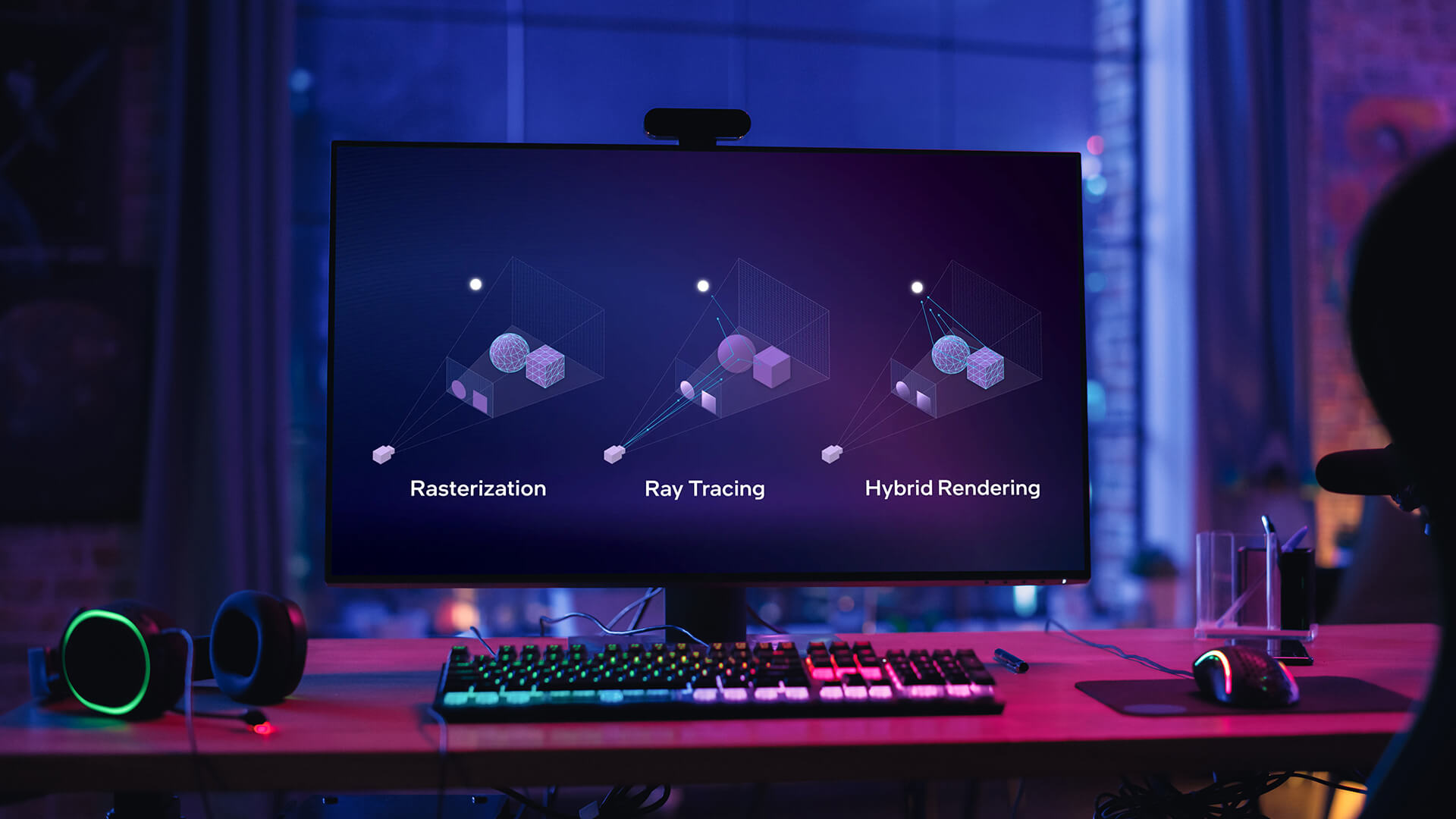
For Visual Quality
If you want the best visual quality and have powerful hardware, path tracing is the better option. It gives more realistic lighting, softer shadows, better reflections and more natural scenes.
It is especially impressive in cinematic single-player games where immersion matters more than competitive FPS.
To get the most from it, pair a high-end GPU with 4K monitors for detailed visuals or immersive curved screens.
For Performance
If you care about frame rate, ray tracing is usually the better choice. It still improves visuals, but it is easier to run than full path tracing.
You can often adjust ray tracing settings to find a good balance. For example, you might turn on ray-traced reflections but leave path tracing off.
For laptops, choose laptops with ray tracing support if you want modern visuals in a portable setup.
For Everyday Gaming
For most everyday gamers, standard ray tracing is the more practical option. It gives a noticeable visual upgrade without requiring the absolute highest-end hardware.
Path tracing is better if:
- You play cinematic single-player games
- You have a high-end RTX GPU
- You use DLSS or similar upscaling
- You are happy to trade FPS for realism
- You want the most advanced lighting possible
Ray tracing is better if:
- You want good visuals and smoother FPS
- You play competitive games
- You use mid-range hardware
- You want a more balanced experience
- You do not want to rely heavily on upscaling
Final Thoughts: Is Path Tracing the Future?
The best option depends on what you value most. If you want smoother performance, use ray tracing. If you want the most realistic visuals and have the hardware to support it, try path tracing.
To experience these technologies at their best, browse next-gen GPUs for path tracing at box.co.uk, compare powerful PCs for modern games, explore laptops with ray tracing support, upgrade to 4K monitors for detailed visuals, or pair your build with CPUs for demanding workloads.
FAQs
What is path tracing?
Path tracing is an advanced rendering technique that simulates light bouncing around a scene many times. It creates highly realistic lighting, shadows, reflections, and colour bleeding.
What is ray tracing?
Ray tracing is a rendering method that follows rays of light to create more realistic effects such as reflections, shadows, and lighting in games and 3D scenes.
What is the difference between ray tracing and path tracing?
Ray tracing usually improves selected effects such as reflections or shadows. Path tracing simulates a more complete lighting system, making scenes look more realistic but requiring much more performance.
Is path tracing better than ray tracing?
Path tracing is better for realism, but ray tracing is better for performance. The best choice depends on your hardware and whether you prefer visual quality or higher FPS.
Can RTX cards do path tracing?
Yes, RTX cards can run path tracing in supported games, but performance depends on the GPU. Higher-end RTX cards are much better suited to path tracing, especially with DLSS enabled.
Does path tracing reduce FPS?
Yes, path tracing can reduce FPS significantly because it is much more demanding than standard ray tracing. DLSS, Frame Generation, and Ray Reconstruction can help improve performance.
Is path tracing real ray tracing?
Yes. Path tracing is a form of ray tracing. It is a more complete and physically accurate method that simulates many light paths and bounces for more realistic rendering.
You can pay with:
*PayPal Credit Representative Example: Assumed credit limit £1,200, Representative 23.9% APR (variable). Purchase rate 23.9% p.a (variable).Terms & Conditions apply.


PayPal Credit and PayPal Pay in 3 are trading names of PayPal UK Ltd, 5 Fleet Place, London, United Kingdom, EC4M 7RD. Terms and conditions apply. Credit subject to status, UK residents only, Five Tech LTD acts as a broker and offers finance from a restricted range of finance providers. PayPal Pay in 3 is not regulated by the Financial Conduct Authority. Pay in 3 eligibility is subject to status and approval. 18+. UK residents only. Pay in 3 is a form of credit. Check if affordable and how you will repay. May make other borrowing more difficult or expensive. See product terms for more details.
Copyright © 1996-2026 Fivetech LTD | Terms and Conditions
box.co.uk & Box are trading names of Five Tech Limited. Registered office: Box LTD, Unit 10 Woodford Trading Estate, Woodford Green IG8 8HF