


 Menu
MenuMenu


Get Sales Advice from Mon - Fri 9am - 5:00pm:
020 3337 8950LAST UPDATED: February 09, 2026
Lenovo Yoga Pro 9i Aura Edition and Beyond: Tandem OLED and RTX 50-Series Laptops Explained
The Lenovo Yoga Pro 9i Aura Edition sits at the intersection of power, premium design, and next-generation laptop technology.
As laptops move further into AI-assisted workflows, high-brightness OLED displays, and RTX-powered performance, this model represents Lenovo’s vision of what a high-end professional laptop should look like in 2026.
Rather than chasing ultra-thin design at the expense of capability, the Yoga Pro 9i Aura Edition focuses on sustained performance, visual quality, and long-term usability.
With the Yoga Pro 9i, Lenovo is clearly aiming for the complete package; the question is, does it actually deliver?
|
Lenovo Yoga Pro 9i Aura Edition (Gen 10) - Quick Overview The Lenovo Yoga Pro 9i Aura Edition is a premium, 16-inch powerhouse designed specifically for creators and power users. It balances high-end performance with a portable chassis, though it demands a significant financial investment.
Trade-offs to Know:
|
What Is the Lenovo Yoga Pro 9i Aura Edition?

If you’ve ever felt that slim, premium laptops look great but struggle when workloads ramp up, the Lenovo Yoga Pro 9i Aura Edition is Lenovo’s answer. It’s designed for users who want consistent, everyday power, not just impressive specs while still delivering the look and feel of a high-end, well-built machine. Rather than chasing ultra-light designs or all-day battery life at any cost, Lenovo has prioritised performance and display quality, pairing a large, high-resolution OLED screen with high-end Intel processors and RTX-powered graphics capable of handling demanding tasks smoothly.
The "Aura Edition" label helps clarify who this laptop is built for. Within Lenovo’s lineup, Aura Edition models receive extra attention through better displays, stronger configurations, and tuning aimed at users who go beyond basic browsing and office work. In practical terms, this places the Yoga Pro 9i Aura Edition above models like the Lenovo Slim 9i Pro and Lenovo Yoga Slim 9i Pro when sustained performance and graphical capability matter.
Why 2026 Laptops Are Changing
In 2026, performance is no longer just about speed; it’s about how well a laptop handles modern workloads, visual demands, and emerging AI tools without getting in the way.
The Lenovo Yoga Pro 9i Aura Edition is a good example of how manufacturers are responding to those changes.
On-device AI is Becoming Standard
AI is no longer something that only lives in the cloud. More laptops are now designed to handle AI-assisted tasks directly on the device, which makes everyday tools faster, more responsive, and more private. From image enhancement and video processing to transcription and smart productivity features, local AI processing reduces delays and limits how often your data needs to leave your laptop.
This shift is why AI-powered laptops are becoming a category in their own right. Hardware like modern CPUs and RTX-powered GPUs is now expected to support AI workloads efficiently, rather than treating them as an optional extra. For users, this means smoother performance today and better support for the tools that will become standard over the next few years.
Displays are Shifting to Brighter, More Efficient OLED
Screens are no longer just something you look at; they’re central to how comfortable and productive a laptop feels. Standard LCD panels struggle to keep up with modern expectations around brightness, contrast, and colour accuracy, especially for people working visually or spending long hours in front of a screen.
That’s why premium laptops are moving toward OLED, and more recently, toward brighter and more efficient OLED technologies like Tandem OLED. These displays deliver deeper contrast, more accurate colours, and improved visibility in different lighting conditions, while also managing power more effectively than older OLED panels.
For users, the benefit is simple: text looks clearer, visuals look more realistic, and long work sessions are easier on the eyes whether you’re editing content or just working across multiple apps.
GPUs now Matter for Creative and AI Workloads
Not long ago, a dedicated GPU was mainly relevant for gaming. That’s no longer the case. Modern creative software, video tools, 3D applications, and AI-assisted workflows all rely heavily on GPU acceleration to run smoothly.
This is why RTX-powered laptops and RTX 50-Series powered laptops are becoming more common in professional and creator-focused machines. A capable GPU doesn’t just improve performance in specialist software; it also helps future-proof your laptop as more applications start using GPU acceleration by default.
For buyers, this means choosing a laptop with a capable GPU isn’t about maximum power for its own sake. It’s about ensuring the system stays responsive, relevant, and capable as workloads continue to evolve.
Tandem OLED Explained
Laptop screens have improved a lot in recent years, but not all OLED displays are created equal. Tandem OLED is one of the biggest reasons premium laptops like the Lenovo Yoga Pro 9i Aura Edition stand out visually, especially if you care about brightness, colour accuracy, and long-term screen quality.
What is Tandem OLED actually?
A Tandem OLED display uses two OLED light-emitting layers stacked on top of each other, rather than relying on a single layer like traditional OLED screens. By sharing the workload between two layers, the display can produce more light without pushing each layer as hard.
For you, this means the screen can get much brighter while staying efficient and stable. On laptops like the Lenovo Yoga Pro 9i Aura Edition, this allows for a vivid, high-resolution OLED display that remains comfortable to use whether you’re working indoors, near windows, or in brighter environments.
It’s still OLED at heart with deep blacks and pixel-level control but with fewer of the compromises that older OLED laptop panels had to make.
Tandem OLED vs Standard OLED
| Feature | Standard OLED | Tandem OLED |
| Brightness | Good peak brightness, but can struggle in very bright environments | Significantly higher peak brightness, making HDR content more impactful and improving visibility for everyday work |
| HDR Performance | Strong contrast, but limited peak brightness for highlights | Much stronger HDR performance with brighter highlights and better detail |
| Power Efficiency | Higher brightness can increase power draw | More efficient, as brightness is shared across two OLED layers |
| Longevity | More prone to pixel wear over time with static content | Improved durability with reduced burn-in risk due to shared electrical load |
|
Visual Quality |
Perfect blacks, strong contrast, accurate colours | All standard OLED benefits, plus better brightness consistency and long-term stability |
| Best For | General premium laptop use | Creative work, HDR content, long sessions, and professional use |
RTX 50-Series Laptops Explained
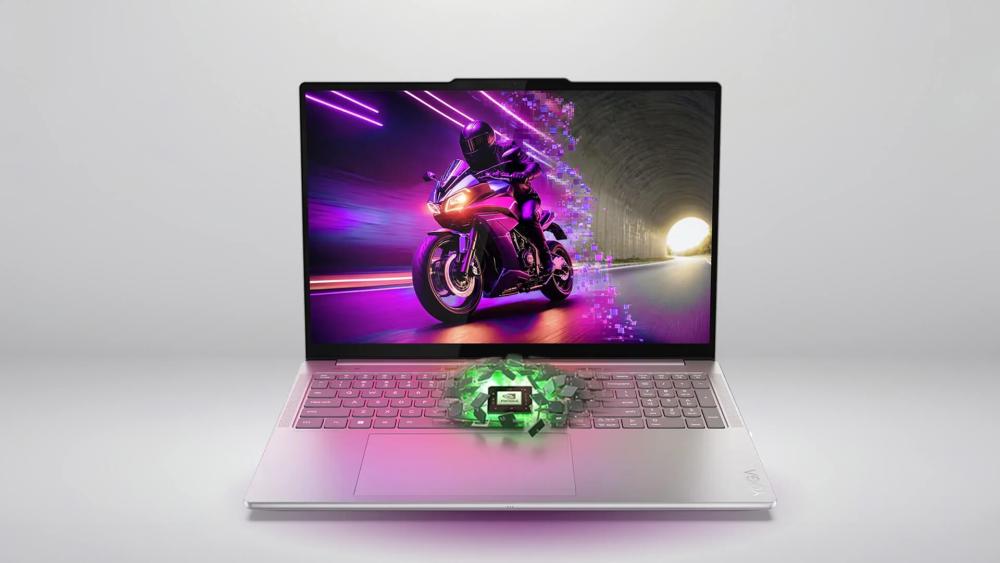
RTX 50-Series laptops mark a bigger shift than a typical generational upgrade. Built on NVIDIA’s Blackwell architecture and introduced in early 2025, this generation is less about raw numbers and more about how AI, graphics, and efficiency work together in real-world workflows.
At the core of RTX 50-Series powered laptops is a much stronger focus on AI-driven rendering and efficiency. One of the standout additions is DLSS 4, which introduces Multi-Frame Generation. Instead of generating a single AI-assisted frame, the GPU can now create up to three AI frames between two rendered frames. In practical terms, this can deliver dramatically smoother performance in demanding 3D applications and games, with frame rates many times higher than native rendering alone.
RTX 50-Series laptops also move entirely to GDDR7 memory, delivering significantly higher bandwidth than previous generations. This matters for tasks like 3D rendering, video editing, and large creative projects, where faster memory helps prevent slowdowns when working with complex scenes or high-resolution footage. Combined with improvements like NVIDIA Reflex 2, which reduces latency even in AI-enhanced workloads, the overall experience feels more responsive and fluid.
AI Features and Creator Acceleration
This generation is where RTX laptops truly start to feel like portable AI workstations. With 5th-generation Tensor Cores, RTX 50-Series GPUs can deliver massive AI processing capability, enabling advanced local AI workflows rather than relying on cloud services.
Features like FP4 precision support allow generative AI models to run faster while using less VRAM, making tools such as image generation, upscaling, and AI-assisted design more practical on a laptop. NVIDIA’s Neural Rendering suite, including Neural Shaders and Neural Faces, also enables more realistic visuals using fewer resources is a big advantage for creators working in 3D, animation, or virtual production.
For video creators, the benefits are very tangible. 9th-generation NVENC encoders allow faster exports, while new hardware-accelerated 4:2:2 decoding ensures smooth playback of professional video formats in applications like DaVinci Resolve and Premiere Pro, without relying on proxies. Add in improved NVIDIA Broadcast features for voice and video enhancement, and RTX 50-Series laptops become genuinely useful tools for modern creative and remote workflows.
RTX 50 vs RTX 40: What Upgrades to Expect?
| Area | RTX 40-Series Laptops | RTX 50-Series Laptops |
| Architecture | Ada Lovelace | Blackwell |
| AI Performance | Strong AI acceleration, but limited by earlier Tensor Core design | Much faster AI processing with 5th-gen Tensor Cores, designed for local AI workflows |
| Frame Generation | DLSS 3 with single-frame generation | DLSS 4 with Multi-Frame Generation (up to three AI frames per rendered frame) |
| Memory Type | GDDR6 / GDDR6X | GDDR7 with significantly higher bandwidth |
| VRAM Capacity | Lower VRAM on entry and mid-range models | Increased VRAM across more models, better for large projects |
| Creative Workloads | Good performance in editing and 3D apps | Faster exports, smoother timelines, and better handling of complex scenes |
| Video Encoding & Decoding | Strong NVENC support, limited 4:2:2 handling | 9th-gen NVENC and hardware-accelerated 4:2:2 decoding for pro video workflows |
| Power Efficiency | Improved over earlier generations | Up to 40% better efficiency with Blackwell Max-Q optimisations |
| Battery Impact | Performance drops more quickly on battery | Better sustained performance while unplugged |
| Long-Term Relevance | Still capable, but nearing mid-cycle | More future-proof for AI-driven software and next-gen creative tools |
Lenovo Yoga Pro 9i Aura Edition Specs Overview
The Lenovo Yoga Pro 9i Aura Edition is clearly built with performance and visual quality in mind, and its hardware choices reflect that focus throughout.
Display and Visual Experience
The Yoga Pro 9i Aura Edition features a large 16-inch Tandem OLED display with a sharp 3.2K resolution, delivering excellent clarity, deep contrast, and accurate colours. The higher peak brightness makes it easier to use in brighter environments than standard OLED laptop panels, while the 120Hz refresh rate keeps everything feeling smooth; from scrolling and multitasking to creative timeline work.
Touch support adds flexibility without turning the laptop into a full 2-in-1. The hinge allows the display to lay flat when needed, keeping the design practical and durable rather than overly complex. For users who spend long hours in front of the screen, this display offers both visual confidence and day-to-day comfort.
Performance Stack
Under the hood, the Yoga Pro 9i Aura Edition is tuned for demanding workloads. High-end configurations combine Intel’s Core Ultra 9 processor with RTX 50-Series laptop GPUs, delivering strong performance across productivity, creative software, and AI-assisted tasks.
With support for large amounts of RAM up to 64GB and fast SSD storage, the system handles heavy multitasking and large project files smoothly. In real-world use, it behaves more like a portable workstation than a typical thin-and-light laptop, staying responsive even during longer, intensive sessions.
Battery, Thermals, Portability, and Build Quality
That level of performance does mean battery life is more practical than impressive, especially when the RTX GPU and high-brightness OLED display are in use. For lighter tasks it holds up well, but this is a laptop designed to perform best when plugged in.
Thermals are handled effectively thanks to the slightly thicker chassis and roughly two-kilogram weight, allowing the laptop to sustain performance without excessive fan noise or sudden throttling. Build quality is solid throughout, with an aluminium chassis, thoughtful design touches, and a wide selection of ports including Thunderbolt, USB-A, HDMI, and an SD card reader. While a high-wattage proprietary charger is included for full performance, USB-C charging support adds to everyday convenience.
Overall, the Yoga Pro 9i Aura Edition strikes a clear balance: it prioritises performance, display quality, and long-term capability over ultra-light portability or all-day battery life and it delivers strongly on that promise.
Real-World Performance for Professionals
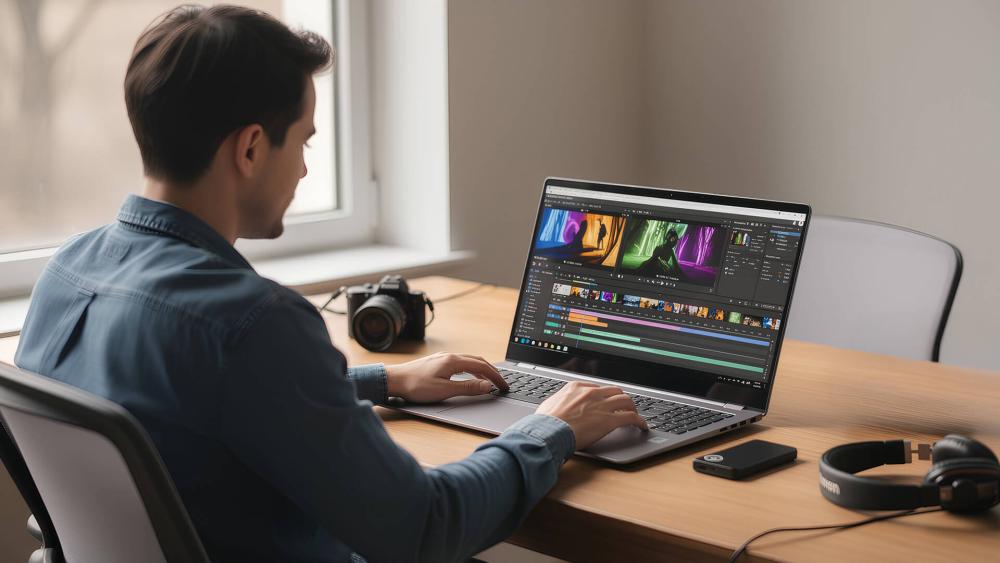
On a day-to-day basis, the Lenovo Yoga Pro 9i Aura Edition feels built for people who actually push their laptops beyond basic tasks. It doesn’t just perform well in short bursts; it stays responsive when workloads stack up.
Content creation (photo, video, colour grading, 3D)
For creative work, the combination of a high-brightness Tandem OLED display and RTX 50-Series graphics makes a noticeable difference. Photo editing and colour grading feel more accurate thanks to wide colour coverage, while video timelines scrub smoothly and exports complete faster with GPU acceleration. For 3D work, the system handles complex scenes and previews confidently, without the slowdowns you often see on thinner laptops.
Productivity and multitasking (office, research, remote work)
Even outside creative software, the Yoga Pro 9i Aura Edition excels at heavy multitasking. Large spreadsheets, multiple browser windows, virtual meetings, and research tools can all run together without the system feeling strained. The large display also helps here, giving you room to work comfortably without constantly switching windows.
AI-assisted workflows (local tools, acceleration, privacy)
Where this laptop really feels future-ready is AI-assisted work. RTX acceleration allows many AI tools to run locally, which improves performance and reduces reliance on cloud services. That means faster results, better responsiveness, and more control over sensitive data, a growing priority for professionals.
Who Should Buy the Yoga Pro 9i Aura Edition?
| User Type | Why It Makes Sense |
| Creators (designers, editors, photographers) | Excellent display quality, RTX acceleration, and strong sustained performance for visual and creative workloads |
| Professionals (consultants, analysts, managers) | Fast multitasking, premium build, large screen, and long-term performance headroom |
| Who should skip it | Budget-focused buyers, users who need all-day battery life, or gamers who want maximum GPU power above all else |
Yoga Pro 9i vs Other RTX 50-Series Laptops
When comparing the Yoga Pro 9i Aura Edition to other RTX 50-Series laptops, the key difference comes down to balance. Gaming laptops usually deliver higher peak GPU power, but they’re often heavier, louder, and less refined for everyday work. The Yoga Pro 9i trades extreme gaming performance for a more portable, polished design with a standout display and better day-to-day usability.
Compared to other creator-focused laptops, it stands out for its screen quality and overall finish; while some alternatives may offer slightly stronger GPUs, few match the same balance of display, build quality, and consistent performance. If your work centres on visual tasks, multitasking, and AI-assisted tools, the Yoga Pro 9i Aura Edition is the better fit, whereas users focused primarily on maximum frame rates or GPU-heavy gaming may be better served by a dedicated gaming laptop.
Buying Checklist Before You Choose
What specs to prioritise
Focus first on GPU tier, followed by RAM capacity, storage speed, and display quality. These have the biggest impact on real-world performance and longevity.
Which configurations make sense for each job
Creators should prioritise higher RAM and RTX configurations, while productivity-focused professionals can opt for more balanced setups without sacrificing responsiveness.
When to buy
Premium laptops like this often see the best value during refresh cycles, promotions, or seasonal deals. Timing your purchase can make a meaningful difference on high-end configurations.
Final Thoughts!
The Lenovo Yoga Pro 9i Aura Edition isn’t designed to be the lightest or longest-lasting laptop on battery and that’s exactly the point. It’s built for people who need reliable performance, a top-tier display, and hardware that won’t feel limited as software and workflows continue to evolve.
If you’re exploring Best Lenovo Yoga laptops, comparing AI-powered laptops, or looking at RTX 50-Series powered laptops that balance power with refinement, the Yoga Pro 9i Aura Edition stands out as one of the most well-rounded options available. At the same time, Lenovo’s wider range also includes affordable Lenovo laptops for users who don’t need this level of performance but still want dependable build quality and everyday reliability.
You can explore the latest Lenovo Yoga laptops, RTX-powered laptops, and AI-ready systems at Box.co.uk, where you’ll find expert-picked configurations and trusted advice to help you choose the right setup for your work.
Frequently Asked Questions
Is the Lenovo Yoga Pro 9i any good?
Yes. The Lenovo Yoga Pro 9i is a premium laptop designed for strong performance, excellent display quality, and long-term usability, making it a solid choice for creators and professionals.
What is the Aura Edition of Lenovo Yoga?
Aura Edition models are enhanced versions of Lenovo Yoga laptops, featuring upgraded displays, stronger hardware configurations, and tuning aimed at users with more demanding workloads.
What is the lifespan of a Lenovo Yoga laptop?
With normal use and proper care, a Lenovo Yoga laptop typically remains reliable and performant for 3-7 years, especially higher-spec models designed for demanding tasks.
What is the best time of year to buy a Lenovo laptop?
The best time to buy is usually during seasonal sales, major shopping events, or when new model refreshes are released, as older configurations often see price drops.
What should I buy instead if I want gaming performance?
If gaming is your main priority, a dedicated gaming laptop with higher sustained GPU power will offer better performance than a creator-focused device like the Yoga Pro 9i.
You can pay with:
*PayPal Credit Representative Example: Assumed credit limit £1,200, Representative 23.9% APR (variable). Purchase rate 23.9% p.a (variable).Terms & Conditions apply.


PayPal Credit and PayPal Pay in 3 are trading names of PayPal UK Ltd, 5 Fleet Place, London, United Kingdom, EC4M 7RD. Terms and conditions apply. Credit subject to status, UK residents only, Five Tech LTD acts as a broker and offers finance from a restricted range of finance providers. PayPal Pay in 3 is not regulated by the Financial Conduct Authority. Pay in 3 eligibility is subject to status and approval. 18+. UK residents only. Pay in 3 is a form of credit. Check if affordable and how you will repay. May make other borrowing more difficult or expensive. See product terms for more details.
Copyright © 1996-2026 Fivetech LTD | Terms and Conditions
box.co.uk & Box are trading names of Five Tech Limited. Registered office: Box LTD, Unit 10 Woodford Trading Estate, Woodford Green IG8 8HF