


 Menu
MenuMenu


Get Sales Advice from Mon - Fri 9am - 5:00pm:
020 3337 8950LAST UPDATED: March 06, 2026
iPad Air M4 vs iPad Air M3: Performance, Battery & Features Compared
Apple has officially unveiled the new iPad Air M4, now available to pre-order and launching on March 11. With upgraded performance, enhanced AI capabilities and the introduction of a larger 11inch and 13-inch model, the latest iPad Air marks a significant step forward for Apple's popular tablet range.
But how does it compare to the previous iPad Air M3 model? And more importantly, should you upgrade in 2026?
In this detailed iPad Air M4 vs M3 comparison, we break down performance, battery life, display quality, connectivity, Apple Intelligence features and overall value to help you decide which model is right for you.
If you're browsing the latest iPad models, you can explore the full range at Box.co.uk.
Quick Overview: iPad Air M4 vs iPad Air M3
|
Feature |
iPad Air (M3) |
iPad Air (M4) |
|
Chip |
Apple M3 chip |
Apple M4 chip |
|
CPU |
8-core (4P + 4E) |
8-core (3P + 5E) |
|
GPU |
9-core GPU |
9-core GPU |
|
Neural Engine |
16-core |
16-core (3x faster vs M1) |
|
Memory |
8GB RAM |
12GB unified memory |
|
Memory Bandwidth |
100GB/s |
120GB/s |
|
Display |
11-inch Liquid Retina display (2360 x 1640) | 13-inch Liquid Retina display (2732 x 2048) |
11-inch Liquid Retina display (2360 x 1640) | 13-inch Liquid Retina display (2732 x 2048) |
|
Peak Brightness |
500 nits |
500 nits |
|
Weight |
1.02 pounds (11-inch) | 1.36 pounds (13-inch) |
1.01 pounds (11-inch) | 1.35 pounds (13-inch) |
|
Storage |
128GB, 256GB, 512GB, 1TB |
128GB, 256GB, 512GB, 1TB |
|
colours |
Blue, Purple, Starlight, Space Gray |
Blue, Purple, Starlight, Space Gray |
|
Connectivity |
Wi-Fi 6E |
Wi-Fi 7 |
|
Battery Life |
Up to 10 hours |
Up to 10 hours |
|
Starting Price |
Starts at £599 |
From £599 (11inch) |
Performance Comparison: iPad Air M4 vs iPad Air M3

The headline upgrade in this iPad Air M4 vs iPad Air M3 comparison is, without question, the introduction of Apple's latest silicon: the Apple M4 chip.
Apple claims the new iPad Air M4 delivers:
- Up to 30% faster performance than the iPad Air M3
- Up to 2.3x faster than the M1 iPad Air
While real-world benchmark testing will ultimately confirm those figures in long-term reviews, we already have strong performance indicators from the M4's appearance in the 2024 iPad Pro.
Let's break it down properly.
CPU Architecture: Smarter Efficiency
Both the Apple M3 chip and Apple M4 chip are built using advanced 3nm process technology, which allows for improved performance while maintaining strong energy efficiency. However, their internal CPU configurations differ slightly in ways that affect sustained performance and power management.
Apple M3 Chip
The Apple M3 chip features an 8-core CPU composed of four performance cores and four efficiency cores. It is paired with 8GB of RAM and 100GB/s memory bandwidth. This configuration already offered excellent balance between speed and battery life in the iPad Air M3 11-inch and 13-inch models.
Apple M4 Chip
The Apple M4 chip also uses an 8-core CPU, but its core layout shifts to three performance cores and five efficiency cores. It is supported by 12GB of unified memory and 120GB/s memory bandwidth. While it might initially appear that reducing the number of performance cores is a step back, the architectural improvements and higher memory throughput allow the M4 to deliver better sustained performance under load.
In practical use, this shift toward additional efficiency cores improves thermal management and long-session stability. Users are likely to experience less thermal throttling during extended tasks such as video editing, gaming or large file exports. Performance remains more consistent over time, rather than peaking briefly and then dropping.
The increase from 8GB RAM in the iPad Air M3 to 12GB unified memory in the iPad Air M4 is arguably the most significant real-world upgrade. More memory allows the system to handle heavier multitasking, larger creative projects and more advanced Apple Intelligence features without slowing down. The jump in memory bandwidth from 100GB/s to 120GB/s further ensures that data can move faster between the CPU, GPU and Neural Engine, which is especially important for AI workloads and professional applications.
Overall, the Apple M4 chip is not just faster in short bursts it is more capable of maintaining high performance consistently, while also improving efficiency. For users investing in the latest iPad Air in 2026, that combination of speed, memory and optimisation makes a meaningful difference in everyday and professional use.
Neural Engine Performance & Apple Intelligence Features
AI is central to the iPad Air 2026 experience.Both generations support Apple Intelligence features, but the M4 is designed to run them more efficiently.
Neural Engine Comparison
|
Feature |
M3 |
M4 |
|
Neural Engine |
16-core |
16-core |
|
Memory |
8GB |
12GB |
|
Bandwidth |
100GB/s |
120GB/s |
The extra memory and bandwidth significantly improve:
- Writing Tools (proofread, rewrite, summarise)
- Smart Reply in Mail
- Live Translation
- Image Playground
- Clean Up tool in Photos
- On-device AI processing
Because Apple Intelligence runs primarily on-device for privacy, memory matters. The M4's architecture ensures smoother performance when AI features are used alongside multiple apps. For users investing in AI-powered workflows, the Apple M4 chip offers better future-proofing.
GPU & Hardware-Accelerated Ray Tracing
Both the Apple M3 chip and Apple M4 chip feature a 9-core GPU with hardware-accelerated ray tracing, but the M4's updated architecture delivers noticeably stronger graphical performance. Hardware-accelerated ray tracing enhances visual realism by enabling more accurate lighting, improved shadow depth, and more natural reflections, resulting in higher overall visual fidelity in supported games and creative applications.
If you use your iPad Air for AAA gaming, 3D rendering, augmented reality applications or professional video production, the iPad Air M4 offers a clear performance advantage.
Display Comparison: iPad Air M4 vs iPad Air M3
When comparing the iPad Air M4 vs M3, there is no generational difference in display quality. Both models use the same Liquid Retina display technology, featuring P3 wide colour, True Tone, full lamination and an anti-reflective coating. Side by side, the M3 and M4 versions look virtually identical. The upgrades in the newer model are internal rather than visual.
11-Inch Models (M3 & M4)
The iPad Air M3 11-inch and iPad Air M4 11-inch both feature a 2360 x 1640 resolution at 264 ppi with 500 nits of peak brightness. Sharpness, colour accuracy and brightness are the same across both generations, meaning there is no visible display improvement when upgrading from M3 to M4 in the 11-inch size.
13-Inch Models (M3 & M4)
The 13-inch versions of both the M3 and M4 offer a 2732 x 2048 resolution at 264 ppi with 600 nits peak brightness. Again, there is no display difference between generations.
However, the 13-inch size itself is noticeably more comfortable for extended work sessions. The larger screen provides more space for multitasking, creative projects and document editing, making it the better choice for users who treat their iPad Air as a primary productivity device.
Should You Upgrade for the Display?
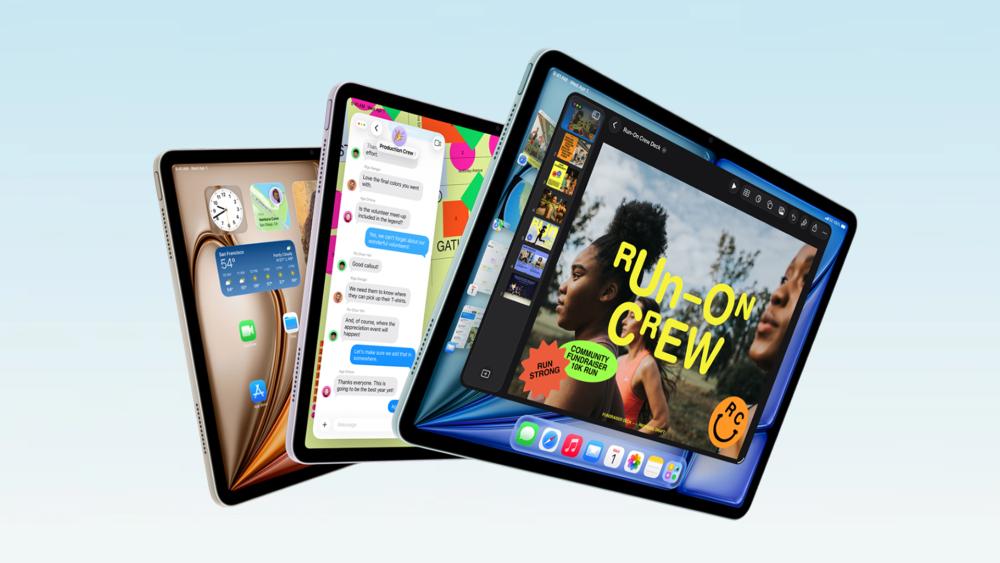
If you looked at the two iPad Air models side by side, you'd be unlikely to see much of a difference. The display technology, brightness levels and visual quality are the same across M3 and M4 within the same size category. The overall design is also unchanged, with both generations featuring the same slim 6.1mm aluminium chassis, flat-edge design, Touch ID in the top button and identical colour options. Visually and physically, the two models are almost indistinguishable.
However, while the exterior remains familiar, the internal upgrades tell a different story. The iPad Air M4 is clearly the faster and more efficient performer, thanks not only to the Apple M4 chipset, but also to the additional 4GB of RAM and improved wireless technologies such as Wi-Fi 7 and Bluetooth 6.
Does that mean you should upgrade from an M3 version? For power users who regularly push their device with demanding apps, AI workflows or heavy multitasking, the added memory and performance headroom may justify the jump. For more casual users, however, the difference may not feel transformative.
That said, unless budget constraints are particularly tight, it would be difficult to recommend choosing the older iPad Air M3 over the newer M4 if you are upgrading from a much older iPad or if you are completely new to Apple's tablets. The internal improvements in performance, efficiency and connectivity make the iPad Air M4 the more future-proof option, even if the display and design themselves remain unchanged.
Battery Life & Efficiency Improvements: iPad Air M4 vs iPad Air M3
Apple officially rates both the iPad Air M3 and iPad Air M4 for the same battery life of up to 10 hours of web browsing on Wi-Fi and up to 9 hours on cellular. In testing, the 11-inch iPad Air M3 achieved around 9 hours and 41 minutes, which aligns closely with Apple's claims. On paper, there is no advertised battery increase with the M4 model. However, the Apple M4 chip is built on refined 3nm process technology and is designed to be more power efficient, meaning performance under load may feel more consistent. Additionally, the introduction of the C1X 5G modem in the cellular M4 models can make a noticeable difference for users who rely heavily on mobile data.
Based on reviews, the newer modem tends to manage power more efficiently during sustained cellular use, potentially delivering better endurance when working away from Wi-Fi. While battery life hours remain officially unchanged, efficiency improvements in the M4 may result in more stable, all-day performance particularly for power users.
Camera Comparison: iPad Air M4 vs iPad Air M3
The 2026 iPad Air M4 features the same camera hardware as the iPad Air M3, meaning there are no major upgrades between the two generations. Both models include a 12MP Wide rear camera with an f/1.8 aperture, supporting up to 5x digital zoom and 4K video recording at 24, 25, 30 or 60 fps. On the front, both devices feature a 12MP landscape camera with an f/2.0 aperture and Centre Stage, which automatically keeps you framed during video calls.
Overall camera capabilities remain consistent, with no advanced features such as ProRes recording or flash included in the Air lineup. The only real distinction comes from the Apple M4 chip's improved image signal processing, which may deliver slightly better photo and video handling but the physical camera sensors themselves are identical.
Connectivity Upgrade: iPad Air M4 vs iPad Air M3
Beyond raw CPU performance, one of the most meaningful differences in the iPad Air M4 vs iPad Air M3 comparison lies in connectivity. While both tablets look nearly identical externally, the newer iPad Air M4 introduces upgraded wireless technologies that improve speed, efficiency and long-term reliability.
N1 Chip (Wireless Networking)
The iPad Air M4 features Apple's newer N1 networking chip, enabling support for Wi-Fi 7, Bluetooth 6 and Thread connectivity. In contrast, the iPad Air M3 supports Wi-Fi 6E and Bluetooth 5.3.
The move from Wi-Fi 6E to Wi-Fi 7 brings noticeable advantages for users with compatible routers. Wi-Fi 7 delivers higher peak speeds, reduced latency and improved stability, particularly in busy network environments such as offices, campuses or shared households. Apple's implementation is also designed to maintain stronger performance on weaker connections, meaning fewer slowdowns when signal strength fluctuates.
Bluetooth 6 is another quiet but important improvement over Bluetooth 5.3 in the M3 model. The newer standard provides more reliable device pairing, lower latency and improved power efficiency. This is particularly beneficial for users who regularly connect accessories such as the Magic Keyboard, Apple Pencil Pro, wireless headphones or external input devices. Over time, these small efficiency gains can contribute to a smoother and more stable experience.
While the iPad Air M3 already offered solid wireless performance with Wi-Fi 6E, the iPad Air M4 is better equipped for modern high-speed networks and future connectivity standards.
New C1X 5G Modem (Cellular Models)
The difference becomes even more significant when comparing the cellular models. The iPad Air M4 introduces Apple's own C1X 5G modem, replacing the Qualcomm SDX70M modem used in the iPad Air M3.
According to Apple, the C1X modem delivers up to 50% faster mobile data performance while using up to 30% less energy. This not only improves download and upload speeds on supported networks but also enhances efficiency during sustained 5G use. For users who rely heavily on mobile data while travelling, commuting or working remotely, this can translate into both faster connectivity and better battery stability.
The improved power management of the C1X modem is particularly relevant for professionals who spend extended periods away from Wi-Fi. While Apple still quotes similar official battery life figures between the M3 and M4 models, real-world cellular use may feel more efficient on the M4 thanks to the modem's lower energy consumption.
In summary, while the iPad Air M3 remains fully capable in terms of wireless performance, the iPad Air M4 offers faster Wi-Fi, more advanced Bluetooth connectivity, and a more efficient 5G modem. For users who prioritise strong, reliable connectivity especially over cellular; the M4 provides a clear and meaningful upgrade.
Final Verdict!
When it comes to choosing between the iPad Air M4 vs iPad Air M3, the decision ultimately depends on how you plan to use your device. If you already own an iPad Air M3 and use it primarily for everyday tasks, streaming or note-taking, there's little urgency to upgrade. However, if you're buying new, upgrading from an older iPad, or want stronger performance, better efficiency and improved connectivity for the years ahead, the iPad Air M4 is the smarter long-term investment.
The display may be the same across generations, but the internal improvements in speed, memory and wireless technology make the latest model more future-ready particularly for power users, professionals and anyone relying on AI-driven workflows.
If you're ready to upgrade or explore your options, browse the full range of iPads and other latest Apple devices at Box.co.uk. You can also shop the latest iPad models and complete your setup with compatible Apple accessories, including keyboards and Apple Pencil.
If budget allows, the M4 is the clear choice for future-proof performance in 2026 and beyond.
You can pay with:
*PayPal Credit Representative Example: Assumed credit limit £1,200, Representative 23.9% APR (variable). Purchase rate 23.9% p.a (variable).Terms & Conditions apply.


PayPal Credit and PayPal Pay in 3 are trading names of PayPal UK Ltd, 5 Fleet Place, London, United Kingdom, EC4M 7RD. Terms and conditions apply. Credit subject to status, UK residents only, Five Tech LTD acts as a broker and offers finance from a restricted range of finance providers. PayPal Pay in 3 is not regulated by the Financial Conduct Authority. Pay in 3 eligibility is subject to status and approval. 18+. UK residents only. Pay in 3 is a form of credit. Check if affordable and how you will repay. May make other borrowing more difficult or expensive. See product terms for more details.
Copyright © 1996-2026 Fivetech LTD | Terms and Conditions
box.co.uk & Box are trading names of Five Tech Limited. Registered office: Box LTD, Unit 10 Woodford Trading Estate, Woodford Green IG8 8HF