


 Menu
MenuMenu


Get Sales Advice from Mon - Fri 9am - 5:00pm:
020 3337 8950LAST UPDATED: April 01, 2026
ASUS vs Dell Laptops: Work Performance, Gaming Power – Which Should You Buy?
Choosing between Asus vs Dell laptops can feel a bit like picking between two strong team comps. Both brands cover work, gaming and everyday use, but they do not always aim at the same kind of buyer.
If you need a machine for spreadsheets, meetings and long office days, the right pick in the Asus vs Dell laptops debate may look very different from the right pick for high refresh gaming, streaming and creative workloads. ASUS tends to spread its range across distinct families such as ExpertBook, Zenbook, Vivobook, TUF Gaming and ROG, while Dell's line-up is often associated with business-focused Latitude and Dell Pro systems, premium XPS models and gaming through Alienware.
This guide makes the choice simpler for you. We will compare Asus vs Dell laptops across eight key differences so you can work out which brand fits your setup best. So let's get into the details.
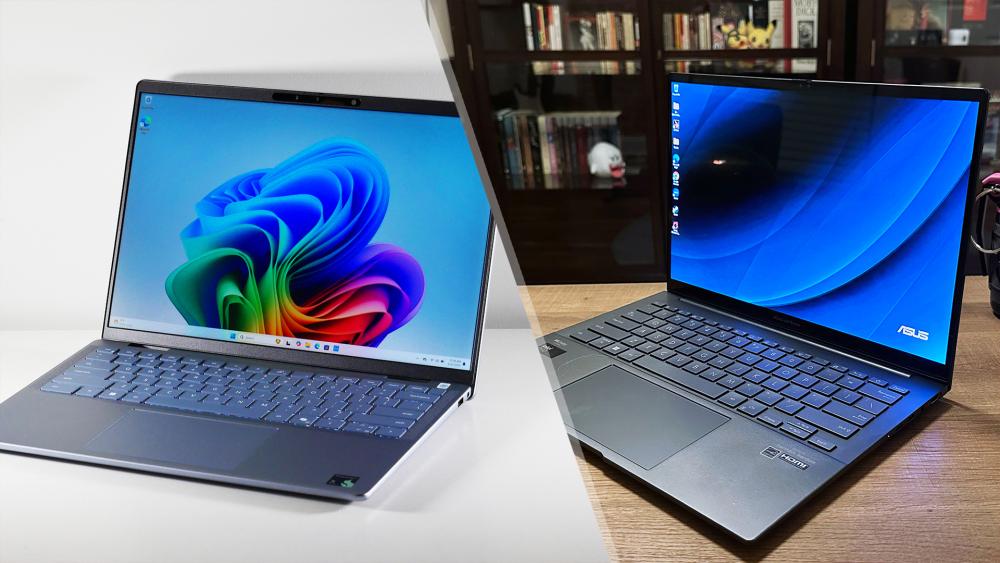
8 Key Differences Between ASUS vs Dell Laptops
Before diving into the detail, here is a quick comparison table for Asus vs Dell laptops for work and gaming.
| Area | ASUS | Dell |
| Product range | Broad spread from Vivobook and Zenbook to ExpertBook, TUF and ROG | Strong work-first identity with Dell, Dell Pro, XPS and Alienware |
| Business focus | Strong with ExpertBook and some Zenbook models | Very strong with Latitude, Dell Pro and wider commercial focus |
| Gaming range | TUF Gaming for value, ROG for high-end gaming | Alienware for premium gaming, fewer mainstream gaming identities |
| Premium design | Zenbook and ROG models are sleek and modern | XPS is the standout premium series for work and creative users |
| Value for money | Often aggressive on specs for the price | Often stronger on support, deployment and business consistency |
| Portability | Strong across Zenbook, ExpertBook and some TUF models | Strong across XPS and Latitude, especially for business travel |
| Enterprise features | Good on selected business models | Usually better known for fleet deployment and office standardisation |
| Best fit | Buyers wanting choice across work and gaming | Buyers wanting a more business-led route with premium gaming at the top |
Now that we are through with the quick comparison, let's dive into the detailed comparison.
1. Product Range and Series Structure
The first big difference in Asus vs Dell laptops is how each brand organises its range. ASUS gives you very distinct families. For work, there is ExpertBook for business, Zenbook for premium portability and Vivobook for more mainstream all-round use. For gaming, ASUS splits things between TUF Gaming and Republic of Gamers, or ROG, which makes it easy to tell whether you are shopping for value or high performance. ASUS positions ExpertBook as a professional line focused on durability, portability and business use.
Dell is a bit more work-led in how people usually shop the brand. When comparing Asus vs Dell laptops, Dell buyers often start with business in mind and then branch out. Latitude and Dell Pro-style machines are central to that business identity, while XPS covers premium portable performance and Alienware covers high-end gaming. That makes Dell's range feel a touch more streamlined for office buyers, even if ASUS offers more obvious segmentation across lifestyle and gaming tiers.
2. Work and business performance
For office and productivity use, Asus vs Dell laptops often comes down to ExpertBook and Zenbook against Latitude, Dell Pro and XPS. ASUS workplace laptops models can be excellent for hybrid work, especially if you want a lighter machine with a modern look and strong everyday performance. ExpertBook, in particular, is designed for professionals and business buyers, with ASUS describing it as durable, portable and built for work.
Dell, though, usually feels more entrenched in the business lane. Dell laptops are popular for business-ready performance, and Dell's Latitude range is explicitly positioned around intelligent productivity and collaboration. In simple terms, that means the Asus vs Dell laptops choice for office use often leans Dell if you want something that feels purpose-built for rollout across teams, hot desks and long-term workplace use. Latitude is the clearer rival to ExpertBook, while XPS makes more sense as a premium alternative to Zenbook.
3. Gaming Power and Gaming Identity
This is where Asus vs Dell laptops comparison gets more interesting for gamers. ASUS has two obvious gaming series. TUF Gaming is the value-focused, rugged range that aims to balance specs and price, while ROG gaming laptops sit higher up with stronger cooling, bolder styling and more premium gaming features. Both of these powerful Asus gaming system ranges are best for specific buyer needs.
Dell's gaming identity is mostly tied to Alienware. In the Asus vs Dell laptops battle for gaming, Alienware is more directly comparable to ROG than to TUF. It is more premium, often pricier, and aimed at buyers who care about top-end performance and standout design. So, if you are comparing series for gaming, TUF Gaming vs a general gaming value buy is one conversation, while ROG vs Alienware is the real head-to-head for enthusiast gaming. And if you are looking for portable gaming laptops that are easier to carry around, Asus is the right choice with their TUF gaming line.
4. Design, Build and Portability
When comparing Asus vs Dell laptops, design matters more than people admit. ASUS has a wider visual spread. Zenbook often goes for sleek and lightweight, ExpertBook looks clean and professional, while TUF and ROG lean harder into gaming style. That gives ASUS more variety, especially with the latest Asus laptops, if you want your laptop to match your use case and your taste.
Dell's premium design reputation is most closely tied to XPS. Dell describes XPS as combining performance with striking design in a thin and light form factor, which is why XPS is such a strong contender when comparing against Zenbook. For business travel, Latitude also keeps Dell highly competitive in the Asus vs Dell laptops discussion, especially if your priority is a machine that feels understated and office-ready rather than gamer-inspired.
5. Value for Money
Value is one of the biggest deciding factors in Asus vs Dell laptops. ASUS often looks stronger on raw specs for the money, especially in Vivobook and TUF Gaming configurations, and that is part of why the brand appeals to buyers who want more RAM, more storage or a better GPU without immediately pushing into premium pricing.
Dell often competes on a different kind of value. Rather than always winning the spec sheet battle, it tends to appeal through business consistency, premium design in XPS and a reputation for workplace suitability. In the Asus vs Dell laptops debate, ASUS often wins the "more hardware for the money" round, while Dell can make more sense if your value calculation includes office deployment, commercial support and familiar business ranges.
6. Business Features and Professional Use
For professional buyers, Asus vs Dell laptops is not just about speed. It is about how suitable the machine feels for daily work. ASUS has a genuine answer here with ExpertBook, which ASUS says is built for professionals with business-minded design and durability. That makes ExpertBook the clearest ASUS series for buyers looking at office-heavy workloads. Zenbook can also work well in this role for users who want a more premium and mobile feel.
Dell still feels slightly stronger if you are buying specifically for a workplace fleet. Latitude has long been associated with business productivity. So, in Asus vs Dell laptops, Dell generally has the edge for buyers prioritising standardised office purchasing, while ASUS remains very appealing for professionals who want a sharper mix of style, portability and performance. Latitude vs ExpertBook is the most useful work comparison, with XPS vs Zenbook making sense for premium professionals.
7. Choice for Mixed Work and Gaming Use
A lot of buyers are not choosing between pure work and pure play. They want one machine that can handle both, and that is where Asus vs Dell laptops can split quite sharply. ASUS usually offers more obvious crossover options. A stronger Zenbook, a high-specced Vivobook or a lighter TUF Gaming laptop can cover office work by day and gaming after hours without feeling wildly out of place. That flexibility is a big reason ASUS is popular with users who want one laptop to do a bit of everything.
Dell can also do mixed use, but the lanes are a bit more separated. XPS is great for premium productivity and some lighter creative or gaming use depending on the spec, while Alienware is more obviously gaming-led. So, if your priority in Asus vs Dell laptops is a balanced all-rounder, ASUS often feels easier to shop. If you want a cleaner divide between work laptop and gaming laptop, Dell's families make that distinction clearer.
8. Who Each Brand Suits Best
The last difference in Asus vs Dell laptops is the type of buyer each brand serves best. ASUS suits people who want lots of choice across price points and use cases. You can move from ExpertBook to Zenbook, or from TUF to ROG, without leaving the brand. That makes ASUS especially handy if you want options across work, gaming and mixed-use machines from one ecosystem.
Dell suits buyers who want a more obviously work-first laptop brand, with premium gaming sitting as a separate step up. If you are a business buyer, office manager or professional comparing Asus vs Dell laptops, Dell often feels simpler to shortlist. If you are a gamer, a student or someone who wants stronger value variety, ASUS usually gives you more routes to explore.

Which Brand Makes More Sense for Your Needs?
The most sensible answer in the Asus vs Dell laptops debate depends on how you will actually use the machine.
If your focus is office work, remote meetings, business software and a more corporate buying path, Dell usually feels like the safer choice. Its work-focused identity is clearer, and high-performance Dell laptops series like Latitude, Dell Pro and XPS line up neatly for professional buyers.
If your focus is gaming or mixed use, ASUS often gives you more flexibility. TUF Gaming is easier to recommend to value-conscious gamers, while ROG gives you a true enthusiast option. On the work side, ExpertBook and Zenbook also mean ASUS does not force you to leave the brand if your needs shift towards productivity.
So rather than asking whether ASUS or Dell is universally better, it is smarter to ask which brand lines up better with your daily routine. In most cases, Asus vs Dell laptops is really a question of work-first structure versus broader all-round choice.

Wrapping Up
The Asus vs Dell laptops comparison is close because both brands cover important ground, but they do it in different ways.
ASUS stands out for variety. It gives buyers clearer pathways between business, mainstream and gaming models, with series like ExpertBook, Zenbook, Vivobook, TUF Gaming and ROG covering a lot of bases. That makes ASUS especially strong if you want choice, flexibility and a better chance of finding a laptop that fits both work and play.
Dell stands out for focus. It remains one of the easiest brands to shop for laptops for professionals, while still offering premium options like XPS and high-end gaming through Alienware. If your buying priority is professional use, structured ranges and a straightforward route to office-ready machines, Dell remains a very strong option.
In the end, the best result in Asus vs Dell laptops comes from matching the series to the job. ExpertBook vs Latitude, Zenbook vs XPS, and ROG or TUF vs Alienware are the comparisons that matter most.
FAQs
Is ASUS Better Than Dell for Gaming Laptops?
For gaming, ASUS often has the broader appeal because it gives you both TUF Gaming for value and ROG for high-end performance. Dell's Alienware range is excellent, but it is more premium-focused. In the Asus vs Dell laptops comparison, ASUS usually gives gamers more choice across different budgets.
Is Dell Better Than ASUS for Work and Productivity?
Dell often has the edge for pure business use because its range is more clearly centred around workplace productivity. Latitude and Dell Pro-style systems are easier to position for office deployment, while XPS gives premium buyers a polished professional option. ASUS is still strong here through ExpertBook and Zenbook, but Dell feels more business-led overall.
Which Brand Offers Better Value for Mixed Work and Gaming Use?
ASUS usually offers better value for mixed use because it has more models that bridge office work and gaming, especially within Vivobook, Zenbook and TUF Gaming ranges. Dell can do mixed use too, but its families tend to separate work and gaming more clearly.
Should I Buy a Dedicated Gaming Laptop or a Work Laptop That Can Also Game?
If gaming is a major priority, a dedicated gaming laptop is the better choice because you will usually get better thermals, graphics performance and display options. If gaming is more occasional, a stronger work laptop may be enough. In the Asus vs Dell laptops debate, ASUS gives you more overlap here, while Dell makes the work-versus-gaming split more obvious.
Are ASUS and Dell both good choices for professionals?
Yes. Dell is often the easier choice for standard office and enterprise buying, while ASUS is a strong option for professionals who want lighter designs, flexible ranges and stronger crossover potential between work and personal use. The best answer in Asus vs Dell laptops depends on whether you value business structure or broader variety more.
You can pay with:
*PayPal Credit Representative Example: Assumed credit limit £1,200, Representative 23.9% APR (variable). Purchase rate 23.9% p.a (variable).Terms & Conditions apply.


PayPal Credit and PayPal Pay in 3 are trading names of PayPal UK Ltd, 5 Fleet Place, London, United Kingdom, EC4M 7RD. Terms and conditions apply. Credit subject to status, UK residents only, Five Tech LTD acts as a broker and offers finance from a restricted range of finance providers. PayPal Pay in 3 is not regulated by the Financial Conduct Authority. Pay in 3 eligibility is subject to status and approval. 18+. UK residents only. Pay in 3 is a form of credit. Check if affordable and how you will repay. May make other borrowing more difficult or expensive. See product terms for more details.
Copyright © 1996-2026 Fivetech LTD | Terms and Conditions
box.co.uk & Box are trading names of Five Tech Limited. Registered office: Box LTD, Unit 10 Woodford Trading Estate, Woodford Green IG8 8HF