


 Menu
MenuMenu


Get Sales Advice from Mon - Fri 9am - 5:00pm:
020 3337 8950LAST UPDATED: February 03, 2026
ARM vs Intel vs AMD in 2026: Are Low-Power Chips Finally Ready for Real PC Gaming?
For most of PC gaming history, the answer to "which CPU should I buy?" was simple: Intel or AMD. ARM chips lived in phones, tablets, and ultra-light devices where efficiency mattered more than raw performance. In 2026, that line is no longer so clear.
With Windows on ARM gaming finally becoming usable, Qualcomm Snapdragon X-series processors entering gaming laptops, and low-power gaming chips delivering better performance per watt than ever, the Arm vs Intel vs AMD gaming debate has moved from theory into real buying decisions. Gamers are now choosing between traditional x86 processors and ARM-based alternatives not just for battery life, but for actual frame rates, consistency, and compatibility.
This guide breaks down what's changed, how ARM compares to Intel and AMD in real-world gaming workloads, and whether low-power chips are finally ready to replace traditional gaming CPU platforms.
If you're browsing gaming laptops for every platform, or comparing the latest Intel processors, new AI-ready laptop chips, and AMD chips for performance builds, this is the context you need before spending your money.
The CPU Shake-Up: Why This Debate Matters in 2026
Gaming Laptops are No Longer Just about Raw Power
For years, gaming CPU comparison focused on clock speeds, core counts, and benchmark wins. That still matters, but it's no longer the whole story. Modern gaming laptops are judged just as much on how long they sustain performance, how quietly they run, and whether they throttle under real workloads.
As GPUs have grown more powerful, CPUs increasingly need to deliver consistent frame times, not just peak numbers. That shift has opened the door for alternative architectures like ARM.
Efficiency, Battery Life, and Thermals now Matter More
In 2026, performance per watt is one of the most important metrics in gaming laptop processors. Players expect long battery life when unplugged, quieter cooling, and fewer thermal spikes especially in thin-and-light gaming designs.
ARM chips excel at efficiency. Intel and AMD have responded with more efficient architectures, but the competition has tightened enough that gamers are now comparing low power gaming chips against traditional high-TDP CPUs.
ARM Enters the Mainstream PC Space
ARM is no longer a niche experiment on Windows. With native execution improving, better driver optimisation, and fewer reliance on CPU emulation, ARM architecture has become a serious option for everyday PCs and potentially for gaming.
The question in 2026 is no longer "can ARM run games?" but "can ARM run games well enough to compete with x86?"
ARM vs Intel vs AMD Gaming: What's Actually Different?
ARM Architecture Explained
ARM processors are built around a RISC (Reduced Instruction Set Computing) philosophy. Instead of handling complex instructions in one go, ARM breaks tasks into smaller, simpler operations that can be executed very efficiently. The result is excellent performance per watt, which is why ARM chips are known for running cooler, quieter, and for much longer on battery power.
Another key difference is ARM's system-on-a-chip (SoC) design. Rather than separating the CPU, GPU, memory controller, and AI accelerators into different components, ARM platforms typically integrate everything onto a single chip. This reduces latency between components and improves efficiency, especially in slim laptops and low-power devices.
That combination of RISC efficiency and tightly integrated design is why ARM dominates smartphones, tablets, and ultra-portable laptops and why it's now being positioned as a serious contender for mainstream PCs. In gaming terms, ARM chips can feel incredibly responsive in lighter workloads, but their design priorities still lean more toward efficiency than sustained high-power output.
Intel & AMD x86 Architecture Explained
Intel and AMD processors use x86 architecture, which is based on CISC (Complex Instruction Set Computing). Instead of simplifying instructions, x86 CPUs are designed to execute more complex operations directly, often in fewer lines of code. This approach has historically favoured raw performance, especially in demanding workloads like games, creative software, and professional tools.
x86 CPUs also operate at higher clock speeds and support higher sustained power limits, particularly in desktops and gaming laptops. That allows Intel and AMD chips to maintain performance during long gaming sessions without relying as heavily on efficiency tricks or burst behaviour.
Another major advantage is ecosystem maturity. Decades of PC software, games, drivers, and tools are built specifically for x86. For gaming, this means fewer surprises: better optimisation, consistent frame pacing, broader anti-cheat support, and reliable compatibility across older and newer titles. This deep software foundation is still one of the strongest arguments in Intel vs ARM and ARM vs AMD gaming comparisons.
Why Architecture Impacts Gaming
Gaming performance isn't just about how fast a CPU is on paper. Architecture affects instruction handling, memory access, scheduling, driver behaviour, and how efficiently the CPU can feed data to the GPU. All of these factors influence frame rates, frame-time consistency, and input latency.
In ARM vs x86 gaming scenarios, ARM chips often benchmark well in synthetic tests but can struggle in real games especially when those games rely on x86 instructions and must run through translation layers. Even small inefficiencies introduced by emulation can lead to stutters, uneven frame pacing, or higher CPU overhead.
Intel and AMD avoid this entirely by running games natively. Their CPUs also benefit from years of game-specific optimisation and close coordination with GPU drivers. This is why, even in 2026, x86 platforms tend to deliver more predictable and consistent gaming performance, particularly for competitive titles or long sessions.
Architecture choices also influence thermal behaviour. ARM's efficiency keeps heat low but may limit sustained boost under heavy load. x86 CPUs generate more heat, but their cooling systems and power budgets are designed to handle prolonged performance without dropping clocks. For gamers, that difference shows how stable a system feels after hours of play, not just in peak FPS numbers.
Gaming Performance: Real-World Expectations
Native Gaming vs Emulation Layers
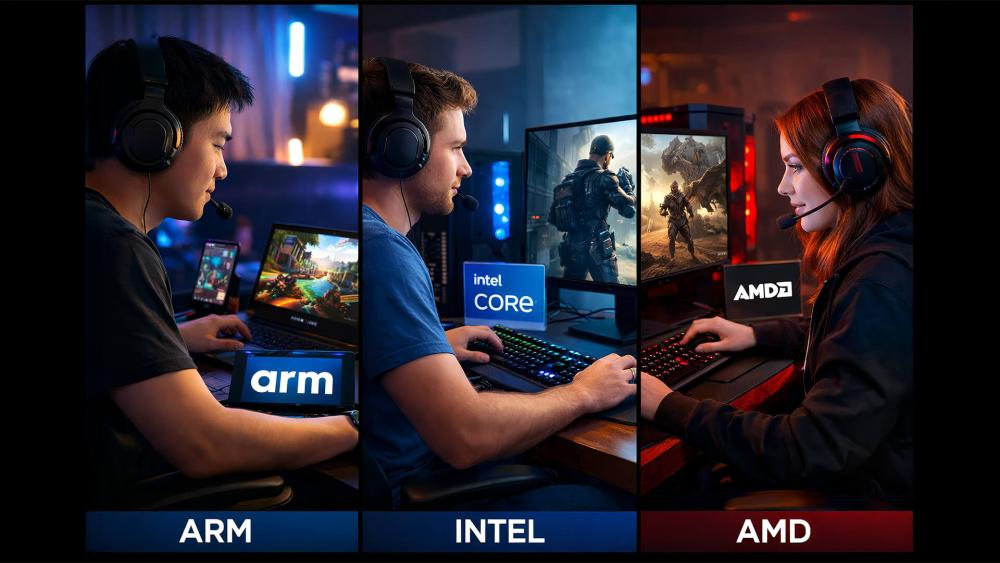
The biggest divider in Windows on ARM gaming today is whether a game runs natively or through an emulation layer. Native ARM builds where the game is compiled specifically for the ARM instruction set can perform surprisingly well. They tend to run cooler, consume less power, and deliver smooth performance in supported titles, particularly newer or lighter games.
However, the reality is that most PC games are still built for x86. When these titles run on ARM, they rely on translation layers that convert x86 instructions into ARM-compatible code in real time. While this works better than many expected, it introduces extra CPU overhead. That overhead can show up as lower minimum frame rates, uneven frame pacing, or higher CPU usage compared to the same game running natively on Intel or AMD.
Intel and AMD avoid this entirely. Because nearly all PC games are designed for x86, they run natively with no translation step, which results in more predictable performance and fewer compatibility surprises.
Frame Rates, Consistency, and Input Latency
On paper, ARM chips can produce respectable average FPS numbers, especially in esports titles or well-optimised games. The difference becomes clearer when you look beyond averages and focus on frame time consistency and input latency.
Competitive gaming relies on stable frame delivery, not just high peaks. Sudden dips, micro-stutter, or delayed frame delivery can affect responsiveness even if the FPS counter looks healthy. This is an area where Intel and AMD CPUs still have an edge, thanks to mature scheduling, driver optimisation, and long-standing game engine support.
For casual gaming, ARM performance can feel perfectly acceptable. For competitive or latency-sensitive gaming, x86 processors still deliver smoother, more predictable results.
Where ARM Still Struggles
ARM's biggest challenges aren't raw performance, but ecosystem gaps. Older games, niche titles, modding tools, and third-party launchers often expect x86 behaviour. Some anti-cheat systems either don't support ARM at all or run inconsistently, which can prevent games from launching.
Mod-heavy games, custom launchers, and legacy titles are particularly hit-or-miss. Even when a game runs, GPU utilisation may not be optimal, leading to performance that feels below what the hardware should be capable of.
Because of this, ARM remains a tougher recommendation for gamers who want a plug-and-play experience across a wide library of games.
Graphics Matters More Than CPU for Gaming
Integrated Graphics on ARM, Intel, and AMD
Integrated graphics have improved significantly across all platforms. AMD's RDNA-based integrated GPUs currently lead in raw gaming performance, particularly in entry-level and thin-and-light systems. Intel's Xe graphics are competitive and continue to improve, while ARM-based GPUs have made noticeable gains in efficiency and capability.
That said, integrated graphics still impose clear limits. Modern AAA games, higher resolutions, and advanced effects quickly expose those limits, regardless of whether the CPU is ARM, Intel, or AMD.
For light gaming, integrated graphics can be enough. For serious gaming, they are rarely the long-term solution.
Discrete GPUs Change the Equation
Adding a dedicated GPU reshapes the entire performance picture. Once a system has a capable discrete graphics card, the GPU becomes the primary performance driver, and the CPU's role shifts to feeding it data efficiently.
This is why discussions around graphics cards that matter more than CPUs dominate gaming performance conversations. Intel and AMD platforms are extremely good at keeping discrete GPUs fully utilised, especially with mature drivers and scheduling.
ARM systems can pair with discrete GPUs, but this is where gaps still appear. Driver maturity, GPU scheduling, and optimisation are improving, but they are not yet as consistent or robust as on x86 platforms.
Driver Maturity and Game Optimisation
Driver quality is one of the quiet foundations of good gaming performance. Intel and AMD benefit from decades of collaboration with game developers, engine creators, and GPU vendors. This results in optimisations that improve frame pacing, reduce stutter, and ensure consistent performance across updates.
ARM platforms are catching up, but driver support is still evolving. New games may run well, while older titles or edge cases expose gaps. Until driver maturity reaches the same level as x86, ARM will remain a more selective choice for gaming.
Power Efficiency vs Sustained Performance

ARM's biggest strength is efficiency. Lower power draw translates into excellent battery life, cooler operation, and quieter systems during light or moderate gaming. This makes ARM laptops attractive for portable gaming and mixed-use scenarios.
Sustained gaming under heavy load tells a different story. Long sessions generate heat, and ARM systems often prioritise efficiency over holding maximum clock speeds indefinitely. This can lead to performance tapering over time.
Intel and AMD systems, especially those built around modern desktop CPUs or high-performance gaming laptop processors, are better suited to maintaining stable clocks under prolonged load. They handle extended gaming sessions with fewer performance drops, even if they consume more power and generate more heat.
Which CPU Platform Fits Your Gaming Style?
| Gaming Style | ARM-Based CPUs (Apple Silicon / Snapdragon) | Intel CPUs | AMD CPUs |
| Casual & Indie Gamers | Well-suited for lighter titles, indie games, and older releases. Excellent battery life, quiet operation, and low heat make ARM appealing for relaxed gaming and mixed daily use. | Works reliably, but often overkill for casual gaming unless paired with integrated graphics for flexibility. | Strong option if using integrated RDNA graphics for light gaming with better compatibility than ARM. |
| Competitive Gamers (Esports) | Not ideal due to input latency risks, inconsistent frame pacing, and limited anti-cheat support in some titles. | Best choice for competitive play thanks to strong single-core performance, stable drivers, and predictable latency. | Also a strong option, especially Ryzen chips with high boost clocks and good value performance. |
| AAA & High-End Gamers | Still limited. Emulation layers, driver maturity, and GPU pairing make ARM a risky choice for modern AAA gaming. | Excellent for AAA gaming when paired with a discrete GPU; broad compatibility and stable long-session performance. | Often the best balance for AAA gaming, offering strong multithreaded performance and excellent GPU pairing. |
| Creators Who Also Game | Works well for editing, productivity, and light gaming, but gaming compatibility can limit flexibility. | Ideal for creators who need maximum software compatibility across games, engines, and creative tools. | Strong all-rounder for gaming + content creation, offering excellent performance-per-pound in many builds. |
| Portable, Battery-Focused Users | Best choice if gaming is secondary and battery life, silence, and mobility matter most. | Improving efficiency, but still trails ARM in battery-focused scenarios. | Better efficiency than Intel in many cases, but still behind ARM for ultra-portable use. |
The 2026 Verdict: Is ARM Ready for Serious Gaming?
ARM has made real progress by 2026, but it still isn't the default choice for serious PC gaming. Low-power ARM chips now deliver impressive efficiency, excellent battery life, and strong everyday performance, making them a compelling option for portable systems and mixed-use laptops. For casual gaming, indie titles, and cloud-based play, ARM no longer feels like a compromise.
That said, gaming at scale still exposes ARM's limits. Inconsistent compatibility, reliance on emulation layers, patchy anti-cheat support, and immature GPU drivers mean performance and stability can vary from title to title. If gaming is a priority rather than a bonus, that unpredictability matters.
Intel remains the safest choice for gamers who want maximum compatibility, consistent frame pacing, and broad support across launchers, engines, and peripherals. AMD, meanwhile, continues to offer the best balance of raw performance, efficiency, and value especially for gamers who also stream, edit, or build performance-focused systems.
In short, ARM is closer than ever, and its future in gaming looks promising. But in 2026, x86 platforms still rule for serious gaming, especially when paired with modern discrete GPUs where graphics cards matter more than CPUs.
If you're weighing up platforms, comparing architectures, or choosing between gaming laptops for every platform, you can explore the latest Intel processors, AMD chips for performance builds, AI-ready laptops, and modern desktop CPUs at Box.co.uk. With a wide range of gaming laptops, processors, and graphics cards in one place, it's easier to find the right setup for how and what you actually play.
You can pay with:
*PayPal Credit Representative Example: Assumed credit limit £1,200, Representative 23.9% APR (variable). Purchase rate 23.9% p.a (variable).Terms & Conditions apply.


PayPal Credit and PayPal Pay in 3 are trading names of PayPal UK Ltd, 5 Fleet Place, London, United Kingdom, EC4M 7RD. Terms and conditions apply. Credit subject to status, UK residents only, Five Tech LTD acts as a broker and offers finance from a restricted range of finance providers. PayPal Pay in 3 is not regulated by the Financial Conduct Authority. Pay in 3 eligibility is subject to status and approval. 18+. UK residents only. Pay in 3 is a form of credit. Check if affordable and how you will repay. May make other borrowing more difficult or expensive. See product terms for more details.
Copyright © 1996-2026 Fivetech LTD | Terms and Conditions
box.co.uk & Box are trading names of Five Tech Limited. Registered office: Box LTD, Unit 10 Woodford Trading Estate, Woodford Green IG8 8HF