


 Menu
MenuMenu


Get Sales Advice from Mon - Fri 9am - 5:00pm:
020 3337 8950LAST UPDATED: January 23, 2026
Is the Apple M5 the Best Laptop Chip for AI in 2026?
AI laptops in 2026 are no longer about ticking a spec sheet box. They are about how well a machine can handle everyday AI tasks locally, without lag, cloud dependency, or battery drain. That is where the Apple M5 chip enters the conversation and why it is already being discussed as a potential benchmark for the next generation of AI-focused laptops.
Apple’s approach to Silicon has always been different, but with recent advances in on-device AI, that gap is widening. While many manufacturers are leaning heavily on cloud-based AI or standalone NPUs, Apple continues to refine a tightly integrated system where hardware, software, and machine learning work together. For users, that means faster responses, better privacy, and AI features that feel genuinely useful rather than experimental.
This also explains why interest in AI laptops in 2026 is increasingly centred around Apple Silicon. From productivity tools to creative workflows and intelligent system features, the shift towards local AI processing is reshaping what people expect from a premium laptop. The Apple M5 chip is positioned as the next step in that evolution, building on earlier foundations while pushing harder into AI-first performance.
In this guide, we break down what makes the Apple M5 chip stand out, how it compares to rival laptop chips, and whether it genuinely earns its place among the best laptop chips for AI this year.
Apple Silicon’s AI Evolution from M1 to M5

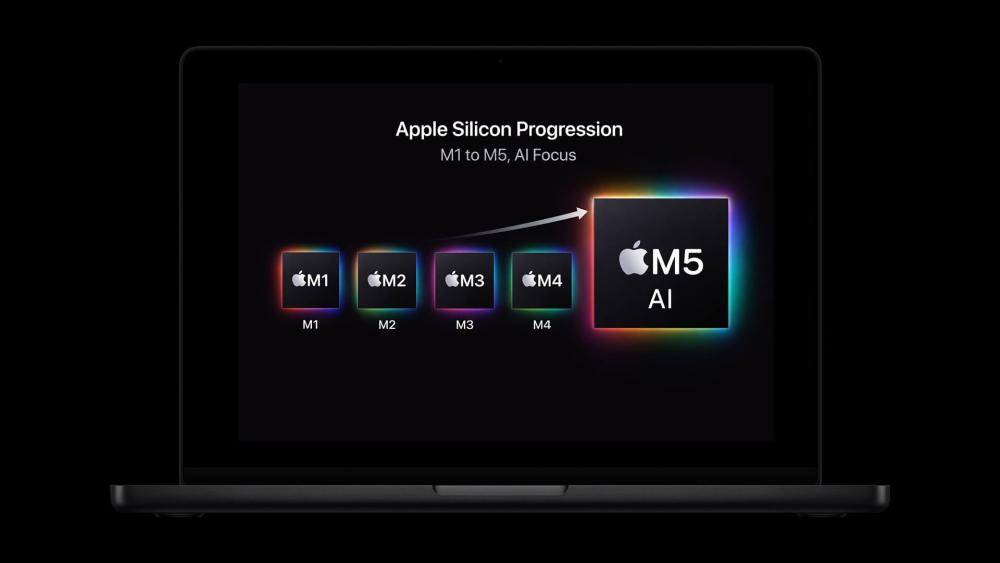
Apple’s move into high-performance AI laptops didn’t happen overnight. Instead, the company has steadily refined its custom silicon for years, starting with the M1 and progressing through M2, M3, and M4. Each generation improved raw performance, efficiency, and machine-learning capabilities — but the Apple M5 chip is the first that Apple itself positions squarely as an AI-focused leap in its Silicon roadmap.
How Apple Silicon Became an AI Powerhouse
When Apple first introduced its own Silicon, the immediate focus was optimisation for macOS and battery life, rather than artificial intelligence. However, with every new iteration, Apple has expanded the capabilities of its Neural Engine and AI acceleration, building a platform where Apple Silicon for machine learning is deeply integrated into the system. This gradual, ecosystem-wide effort means developers and apps are better prepared to take advantage of hardware-level AI acceleration across macOS, rather than retrofitting it later.
The Apple M5 chip reflects this evolution. Announced in October 2025 and now shipping inside the 14-inch MacBook Pro, the M5 represents a significant step toward AI-centric architectures. Importantly, it is not just slightly faster than the M4, Apple touts multiple times higher peak AI performance thanks to next-generation GPU and Neural Engine optimisations, enabling local AI workloads that were previously reserved for specialised hardware or server-based processing.
Where the Apple M5 Chip Fits in Today’s Mac Lineup
The first Macs to receive the Apple M5 chip were announced in late 2025, with the 14-inch MacBook Pro leading the charge. This new model brings a 10-core CPU, 10-core GPU with Neural Accelerators in each core, and a 16-core Neural Engine — hardware specifically tuned to make AI laptops in 2026 more capable of handling on-device tasks such as local model inference, creative generative AI, and accelerated machine learning pipelines.
Although the desktop and larger notebook ranges have not yet been updated with M5 variants, Apple is widely expected to expand support across its product lineup in 2026. Notably, MacBook Air models with the M5 chip are anticipated to arrive in spring 2026, bringing Apple’s AI-focused silicon to thinner, lighter machines which is a clear signal that Apple intends to make powerful, efficient AI processing accessible across users, not just professionals.
Why This Matters for AI Performance
What sets Apple’s approach apart is not just hardware capability but the holistic ecosystem optimiser. Apple designs its chips, operating system, and developer frameworks together, meaning applications can harness the full potential of the Neural Engine and accelerators without fragmenting performance or battery life. This integration underpins why Apple Silicon continues to be among the best laptop chips for AI, particularly for on-device tasks that demand responsive, energy-efficient processing.
What Makes the Apple M5 Chip Different for AI Workloads
The Apple M5 chip is not just a routine generational upgrade. It represents a clear shift in how Apple designs laptop processors, with AI workloads treated as a first-class priority rather than a secondary feature. For anyone comparing best laptop chips for AI in 2026, this is where the M5 starts to separate itself from the competition.
Apple M5 AI Performance Explained Without the Marketing Hype
When people talk about Apple M5 AI performance, it is easy to get lost in headline numbers. What matters more is how the chip behaves in real-world scenarios. The Apple M5 chip is designed to run AI tasks continuously in the background while still handling everyday computing without slowdown.
This means tasks like text generation, image enhancement, voice processing, and smart system automation can run locally without forcing the system to ramp up power usage or rely on cloud services. Compared to previous generations, the Apple M5 chip delivers smoother multitasking when AI features are active, which is increasingly important for AI laptops in 2026 where AI is always on rather than something you trigger manually.
Crucially, this performance is consistent. Instead of short bursts of AI acceleration followed by throttling, the Apple M5 chip maintains stable output over longer sessions. That makes it far more practical for users who rely on AI throughout the day rather than in short, isolated tasks.
Neural Engine Advancements and AI-Specific Acceleration
At the heart of the Apple M5 chip’s AI capability is its latest Neural Engine. Apple has continued to expand both raw throughput and efficiency, allowing more complex models to run locally. This is a major reason the Apple M5 chip is frequently mentioned among the best laptop chips for AI, even when compared to newer Windows-based alternatives.
The Neural Engine works alongside the CPU and GPU rather than competing with them. AI workloads are intelligently distributed, ensuring that image generation, language processing, and real-time analysis do not interfere with traditional performance. This tight integration is especially important for creative and professional users who need AI assistance without sacrificing responsiveness in their main applications.
For MacBook M5 for AI workloads, this translates into faster AI-driven features inside creative apps, smarter system tools, and improved developer performance for machine learning tasks on macOS.
Unified Memory and Why It Matters More Than Ever for AI
Unified memory is one of the most underrated advantages of the Apple M5 chip, particularly for AI. Unlike traditional laptop architectures that split memory between different components, Apple’s unified memory pool allows AI models to access data instantly without duplication or bottlenecks.
For Apple Silicon for machine learning, this is a big deal. Larger models can be loaded and processed locally, making advanced AI features feasible even on thin and light machines. As AI laptops in 2026 increasingly move towards local inference rather than cloud dependency, unified memory becomes a decisive advantage.
In practical terms, the Apple M5 chip handles AI tasks more efficiently, uses less power, and avoids the performance penalties that come from moving data between separate memory pools. That efficiency is a key reason Apple’s latest silicon continues to outperform expectations in everyday AI use.
On-Device AI vs Cloud AI in AI Laptops in 2026
One of the main reasons the Apple M5 chip stands out in 2026 is how Apple approaches AI processing across its laptops. Rather than choosing between on-device or cloud AI, Apple now operates a hybrid AI model that prioritises local processing while selectively using the cloud when tasks exceed what can be handled efficiently on the device.
This shift is central to how AI laptops in 2026 are evolving. While many competitors still depend heavily on cloud-based AI for core features, Apple designs its AI systems to run locally first, using the Apple M5 chip’s Neural Engine and unified memory. Cloud AI is treated as a fallback, not the default, which has a direct impact on speed, privacy, and reliability.
Why Apple Is Prioritising On-Device AI Over Cloud Processing
Apple’s core philosophy remains clear: if an AI task can be processed locally, it should be. The Apple M5 chip is built with enough dedicated AI acceleration to handle tasks like language understanding, image analysis, transcription, summarisation, and system-wide intelligence without a constant internet connection.
This approach reduces dependence on external servers and avoids the performance inconsistencies that often come with cloud-based AI. Latency, throttling, and server availability all affect cloud processing, whereas on-device AI powered by the Apple M5 chip delivers consistent, predictable performance. That reliability is a major reason Apple Silicon continues to be discussed among the best laptop chips for AI, especially for everyday users rather than niche benchmark scenarios.
At the same time, Apple acknowledges that some advanced AI tasks require more compute than even modern laptops can efficiently deliver. This is where Apple’s hybrid model comes into play, rather than forcing everything into the cloud by default.
How Apple Uses Cloud AI Without Sacrificing Privacy
In 2026, Apple’s AI strategy combines on-device processing with Private Cloud Compute, a system designed to extend AI capabilities without compromising user data. When tasks exceed local limits, they can be securely offloaded to Apple-controlled servers running Apple Silicon, rather than third-party infrastructure.
This approach is also where Apple’s collaboration with Google’s Gemini AI models fits in. Apple has confirmed that future versions of Siri and Apple Intelligence will be able to draw on Gemini for complex queries and reasoning, while still keeping personal data protected through Apple’s privacy framework. Sensitive context stays on the device, while larger language model reasoning can be handled securely when required.
For users, this means the benefits of advanced cloud AI without the usual trade-offs. The Apple M5 chip handles the majority of AI tasks locally, and cloud processing is used selectively and transparently, rather than being baked into every feature.
Latency, Reliability, and Offline AI Use Cases
Because on-device AI remains the foundation, MacBooks powered by the Apple M5 chip continue to excel in situations where cloud-dependent laptops struggle. Core AI features work instantly, even when offline or on unstable connections. Real-time transcription, image enhancement, writing assistance, and intelligent automation respond without noticeable delay.
This low-latency behaviour is one of the most visible advantages of Apple M5 AI performance in everyday use. There are no waiting periods, no degraded features while travelling, and no requirement to stay connected just to access basic AI functionality.
As AI becomes a constant background feature rather than a novelty, this consistency matters more than raw theoretical performance. Laptops built around the Apple M5 chip feel dependable in real-world conditions, which is increasingly what defines the best laptop chips for AI in 2026.
Real-World AI Tasks the Apple M5 Chip Is Built For
AI features only matter if they improve how you actually use your laptop. With the Apple M5 chip, Apple has focused less on novelty demos and more on practical, everyday tools that run quietly in the background. This is where Apple M5 AI performance becomes noticeable, especially as AI laptops in 2026 move beyond experimental features and into daily workflows.
Productivity and Everyday AI Features You’ll Actually Use
For most users, the biggest benefit of the Apple M5 chip is how seamlessly AI fits into everyday tasks. Writing assistance, smart summarisation, contextual suggestions, and intelligent organisation all run locally on the device. These features feel instant because they do not rely on constant cloud calls, and they adapt over time without compromising privacy.
The Apple M5 chip also improves system-level intelligence across macOS. Search becomes more context-aware, notifications are prioritised more intelligently, and voice input feels more natural thanks to on-device language processing. These are not flashy features, but they save time throughout the day, which is exactly what many people expect from modern AI laptops in 2026.
For students and professionals alike, this level of responsiveness is what places Apple Silicon among the best laptop chips for AI, even when raw performance figures are not the highest on paper.
Creative AI Workflows for Photos, Video, and Audio
Creative users see some of the clearest gains from the Apple M5 chip. AI-powered tools for photo enhancement, background removal, colour correction, and noise reduction run locally and in real time. Video workflows benefit from intelligent upscaling, stabilisation, and automatic scene detection without long render times or excessive battery drain.
Audio processing is another area where the MacBook M5 for AI workloads stands out. Tasks like voice isolation, automatic transcription, and real-time effects can be handled on the device, making the Apple M5 chip particularly appealing for content creators who work on the move.
Because these tools rely heavily on the Neural Engine and unified memory, performance remains smooth even when working with large files. That efficiency is a key reason Apple Silicon continues to dominate creative workflows on laptops.
AI-Assisted Multitasking and Workflow Automation
As AI becomes more integrated into operating systems, multitasking is no longer just about raw CPU power. The Apple M5 chip enables intelligent automation that adapts to how you work, predicting actions, managing resources, and reducing manual input.
Tasks such as automatically organising files, switching workflows based on context, or triggering shortcuts through natural language all benefit from on-device AI. These features run continuously without causing noticeable slowdowns, which is essential for AI laptops in 2026 where AI is always active rather than something you turn on occasionally.
This ability to blend AI into daily multitasking is where the Apple M5 chip truly shines. It delivers AI that feels practical, reliable, and genuinely useful, reinforcing its position among the best laptop chips for AI available today.
Apple M5 vs Other Best Laptop Chips for AI
With AI now baked into modern operating systems, comparing laptop chips in 2026 is no longer just about CPU or GPU performance. It is about how efficiently a platform can run AI tasks all day, every day. This is where the Apple M5 chip takes a different approach compared to rival processors and why it continues to be mentioned among the best laptop chips for AI.
Apple M5 vs Intel Core Ultra AI Chips
Intel’s Core Ultra range has made clear progress in AI acceleration, particularly with dedicated NPUs designed for Windows AI features. However, most Core Ultra laptops still rely on a more fragmented architecture, with AI workloads split across the CPU, GPU, and NPU depending on the task.
By comparison, the Apple M5 chip benefits from a tightly integrated design. The Neural Engine, CPU, GPU, and unified memory work together under macOS, allowing AI tasks to move seamlessly between components without duplication or bottlenecks. This results in smoother performance for sustained AI workloads, especially when running multiple AI-driven features alongside everyday applications.
In practical use, Intel-based AI laptops can deliver strong peak performance, but they often struggle to match Apple’s efficiency and consistency. For users who value stability, battery life, and low heat output, the Apple M5 chip has a clear advantage in real-world AI scenarios.
Apple M5 vs Snapdragon X Elite AI Laptops
Qualcomm’s Snapdragon X Elite has positioned itself as a serious challenger in the AI laptop space, particularly for thin and light designs. Its focus on efficiency and on-device AI brings it closer to Apple’s philosophy than traditional x86 processors.
Where the Apple M5 chip still pulls ahead is ecosystem maturity. macOS applications, frameworks, and creative tools are already optimised for Apple Silicon, meaning AI features work out of the box without compatibility issues. Snapdragon-powered laptops rely heavily on Windows on ARM support, which, while improving, still presents limitations for some professional and creative workflows.
For users considering AI laptops in 2026, the difference often comes down to software reliability rather than hardware capability. Apple’s integrated approach ensures that AI features feel polished and dependable, rather than experimental.
Why Raw AI Numbers Do Not Tell the Full Story
Many chip manufacturers now advertise AI performance using TOPS figures, but those numbers rarely reflect everyday experience. The Apple M5 chip does not rely on headline-grabbing specs alone. Instead, its strength lies in how efficiently AI tasks are scheduled, prioritised, and sustained over time.
AI workloads are continuous, not occasional. They assist with writing, editing, organising, and system optimisation throughout the day. Chips designed for short bursts of performance can throttle under this kind of load, whereas the Apple M5 chip maintains stable output without excessive power draw.
This is why comparisons based purely on theoretical AI throughput can be misleading. In real-world conditions, the Apple M5 chip delivers a more balanced and reliable experience, reinforcing its reputation as one of the best laptop chips for AI available in 2026.
Performance, Battery Life, and Thermals in AI-Driven MacBooks

As AI becomes a constant background process rather than an occasional tool, sustained performance and efficiency matter more than ever. The Apple M5 chip is designed to handle continuous AI workloads without the trade-offs that traditionally come with high-performance laptops. This balance is a major reason Apple Silicon remains a strong choice for AI laptops in 2026.
Can Fanless MacBooks Sustain AI Workloads?
One of the biggest questions around AI laptops is whether thin, fanless designs can cope with ongoing AI processing. While the Apple M5 chip is already available in MacBook Pro models, the MacBook Air has not yet received an M5 update. However, Apple’s existing fanless designs provide a strong indication of what to expect once the M5 arrives.
Previous Apple Silicon generations in the MacBook Air have demonstrated that everyday AI tasks such as transcription, writing assistance, image processing, and system intelligence can run efficiently without active cooling. The Apple M5 chip builds on this foundation with improved AI acceleration and power efficiency, suggesting that a future M5-powered MacBook Air counts as laptops designed for on-device AI workloads without noticeable thermal throttling.
That said, sustained or professional-grade AI workloads will continue to favour actively cooled systems. Current high-performance MacBook Pro laptops for professionals with the Apple M5 chip are better suited to prolonged AI processing, creative workloads, and heavier multitasking. For users prioritising silent operation and portability, the MacBook Air remains optimised for lighter AI use rather than extended high-intensity workloads.
Battery Efficiency When Running AI Locally
Battery life is where the Apple M5 chip truly stands out. On-device AI avoids the constant network activity and background processing that cloud-based AI requires. This significantly reduces power draw, especially during routine tasks that rely on AI throughout the day.
The Apple M5 chip is optimised to run AI features at low power levels, scaling up only when necessary. This means users can benefit from intelligent features without seeing a noticeable hit to battery life. Compared to many competing platforms, MacBooks equipped with the Apple M5 chip maintain longer unplugged usage even with AI features enabled.
For users choosing between best laptop chips for AI, this efficiency is often more valuable than peak performance numbers. A laptop that lasts all day while running AI tools is far more practical than one that needs frequent charging.
Thermal Behaviour Compared to Actively Cooled AI Laptops
Actively cooled AI laptops can deliver higher sustained performance, but they often do so at the cost of noise and heat. The Apple M5 chip takes a different approach, focusing on thermal efficiency rather than aggressive boosting.
In MacBook Pro models, active cooling allows the Apple M5 chip to maintain higher performance levels for demanding AI and creative workloads without excessive fan noise. Thermal management remains controlled, even during extended sessions, which helps preserve long-term performance and component longevity.
This balance between performance, thermals, and efficiency is what makes the Apple M5 chip well-suited to modern AI workloads. It delivers dependable performance across different MacBook designs, reinforcing its position among the best laptop chips for AI in real-world use.
Which Apple Laptops Use the Apple M5 Chip in 2026
Understanding where the Apple M5 chip sits in Apple’s current lineup is important, especially as AI becomes a deciding factor for buyers. Unlike earlier transitions where new chips rolled out across multiple models at once, Apple has taken a more staged approach with M5, prioritising performance-focused devices first.
MacBook Pro and the Apple M5 Chip Today
As of 2026, the Apple M5 chip is available in the MacBook Pro range, where its AI-focused architecture makes the most immediate sense. These machines are designed for sustained workloads, including creative tasks, development, and advanced AI processing, all of which benefit from active cooling and higher performance headroom.
In MacBook Pro models, the Apple M5 chip is able to run demanding on-device AI features alongside professional applications without compromising stability. This makes the MacBook Pro the most suitable choice right now for users who want to push Apple M5 AI performance beyond everyday assistance and into heavier workflows.
For professionals comparing best laptop chips for AI, this is currently where the Apple M5 chip delivers its most complete experience.
Why the MacBook Air Has Not Yet Received the M5 Chip
The MacBook Air has not yet been updated with the Apple M5 chip, and that is a deliberate product decision rather than a delay. The Air prioritises efficiency, silent operation, and affordability within Apple’s lineup. Introducing a new AI-focused chip into a fanless design requires careful balancing of thermals, battery life, and sustained performance.
Apple has historically introduced new silicon to the MacBook Pro first, refining efficiency and software optimisation before bringing it to thinner designs. Given the increased AI focus of the Apple M5 chip, this staged rollout helps ensure that when it does arrive in a MacBook Air, it delivers consistent performance rather than headline specs alone.
For buyers focused on portability and everyday AI features, current Apple Silicon MacBook Air models remain well-suited to lighter workloads, even without the Apple M5 chip. Browse our range of ultra-light MacBook Air laptops for everyday use that fit your daily routine.
How Apple Mac Desktops Fit Into the M5 AI Ecosystem
While laptops get most of the attention, Apple’s desktop Macs also play a role in the wider Apple Silicon for machine learning ecosystem. Desktop systems benefit from fewer thermal constraints and are better suited to sustained AI workloads, development, and model training.
Although not all Apple Mac desktops have transitioned to M5-based configurations, Apple’s broader Silicon strategy suggests that AI-focused chips like the Apple M5 will increasingly define how both notebooks and desktops handle machine learning tasks. For users working across multiple Apple devices, this consistency helps streamline AI workflows across the ecosystem.
As AI laptops in 2026 continue to mature, the Apple M5 chip represents Apple’s high-performance tier, with its influence expected to shape future updates across both portable and desktop Macs.
Final Word:
The Apple M5 chip makes a strong case as one of the most capable laptop processors for AI in 2026, not because it chases headline numbers, but because of how consistently it delivers real-world AI performance. Apple’s focus on on-device processing, combined with a controlled and privacy-first hybrid cloud approach, results in AI features that feel reliable, fast, and genuinely useful.
What sets the Apple M5 chip apart is balance. AI tasks run locally by default, reducing latency and protecting user data, while more complex requests can securely scale using Apple’s cloud infrastructure and external models such as Google’s Gemini. This allows Apple to offer advanced AI features without turning everyday laptop use into a cloud-dependent experience.
For users who value efficiency, long battery life, and tightly integrated AI across the operating system, the Apple M5 chip stands out among the best laptop chips for AI. It may not be the right choice for every niche workload, but for mainstream productivity, creative use, and future-facing AI features, it represents Apple’s most mature and practical AI laptop platform to date. So, if you want to buy a MacBook, be sure to check our full Apple MacBook laptop lineup at Box.co.uk. We list official Apple products and accessories so be sure to check out the list and choose what suits your needs.
FAQs
Is the Apple M5 chip good for AI?
Yes. The Apple M5 chip is specifically designed with AI acceleration in mind, using a powerful Neural Engine and unified memory to handle on-device AI tasks efficiently and consistently.
Is the Apple M5 one of the best laptop chips for AI?
For real-world use, it is. While some competitors advertise higher theoretical AI numbers, the Apple M5 chip delivers more reliable on-device AI performance, better efficiency, and tighter software integration.
Does the Apple M5 rely on cloud AI?
No. Most AI tasks run directly on the device. Cloud AI is only used selectively for more complex requests, and Apple controls how and when data leaves the device.
How does Siri use AI on Apple M5 laptops?
Siri uses on-device processing for many tasks, with support for more advanced reasoning through Apple Intelligence. Apple has also confirmed collaboration with Google’s Gemini models for handling complex queries securely.
Are MacBooks with the Apple M5 chip future-proof?
Yes. Strong macOS update support, expanding AI features, and Apple’s long-term silicon roadmap make M5-powered Macs well positioned for future AI developments.
Is the Apple M5 chip better for AI than Intel or Snapdragon?
It depends on the workload, but for everyday AI features, creative tools, and consistent battery-friendly performance, the Apple M5 chip offers a more polished experience than most alternatives.
You can pay with:
*PayPal Credit Representative Example: Assumed credit limit £1,200, Representative 23.9% APR (variable). Purchase rate 23.9% p.a (variable).Terms & Conditions apply.


PayPal Credit and PayPal Pay in 3 are trading names of PayPal UK Ltd, 5 Fleet Place, London, United Kingdom, EC4M 7RD. Terms and conditions apply. Credit subject to status, UK residents only, Five Tech LTD acts as a broker and offers finance from a restricted range of finance providers. PayPal Pay in 3 is not regulated by the Financial Conduct Authority. Pay in 3 eligibility is subject to status and approval. 18+. UK residents only. Pay in 3 is a form of credit. Check if affordable and how you will repay. May make other borrowing more difficult or expensive. See product terms for more details.
Copyright © 1996-2026 Fivetech LTD | Terms and Conditions
box.co.uk & Box are trading names of Five Tech Limited. Registered office: Box LTD, Unit 10 Woodford Trading Estate, Woodford Green IG8 8HF